Thayer Hut

 
Thayer Hut.

Thayer Hut.

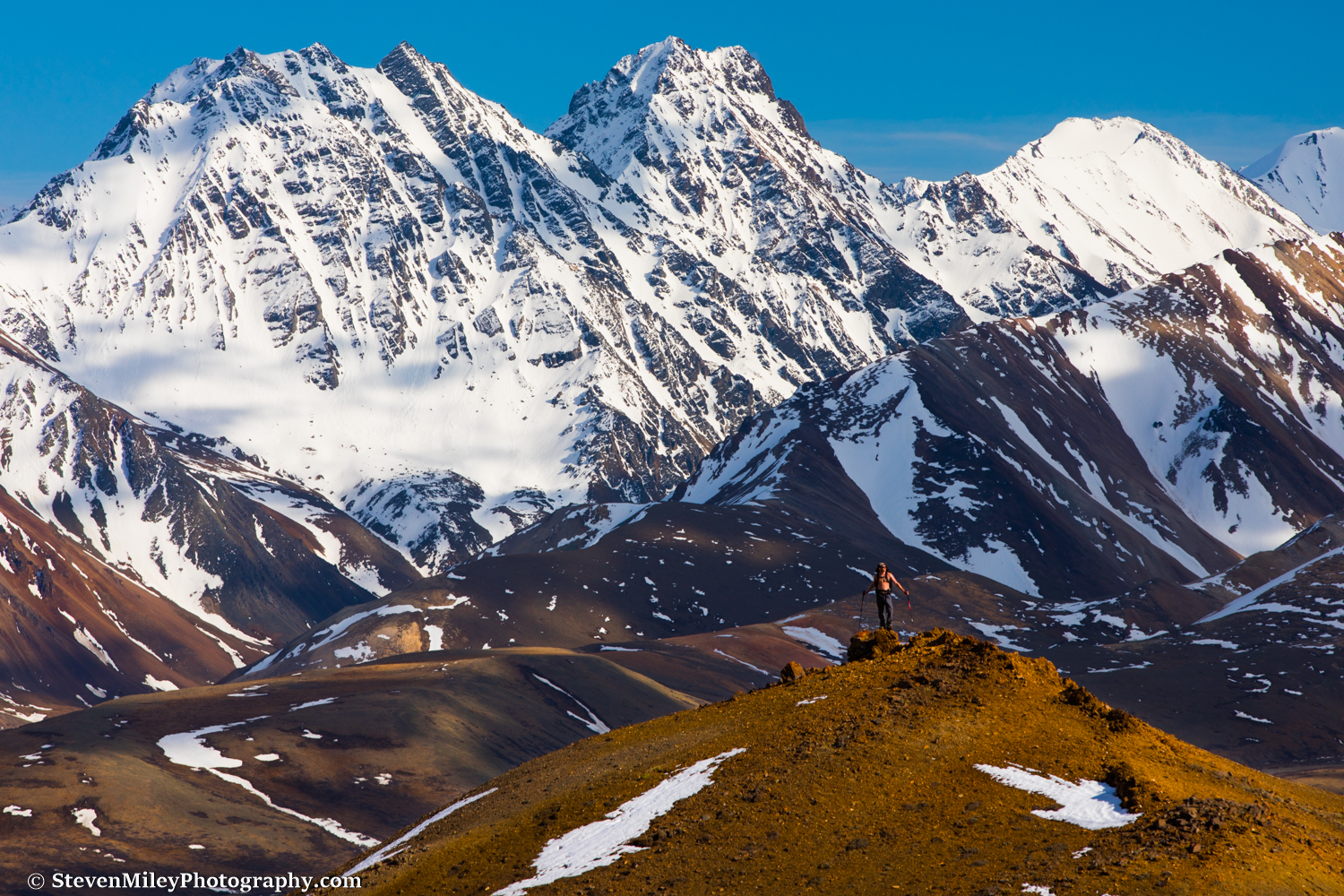
After carrying a heavy pack over the rough moraine of Castner Glacier for seven miles, I wasn't in the mood to scale a treacherously steep and muddy slope. The sun had already set and the purple twilit sky hung over the glaciated peaks of the eastern Alaska Range surrounding me. The dark crevasse at the bottom of the slope was choked with rocks from previous mudslides and, looking up, it appeared there could be another mudslide at anytime. I had scrambled up the same slope three years before and vaguely recalled fearing for my life, but the promise of mountain luxury awaited me and I reluctantly began the ascent.

As I crested the edge of the alpine meadow at the top, there it was: the Thayer Hut. The hut is impossible to see from below on Castner Glacier, and I've encountered people who failed to find it after making the same arduous trek—probably because they imagined it sitting atop a much shorter, less steep slope. For those that do find it, it's like stumbling onto an oasis in the desert, at least for summer visitors; in winter, finding the hut can be more like waking after a heavy snowfall and realizing you have to shovel the driveway before going to work. Fresh Dall sheep tracks crossed my path as I walked the final length to the hut, and when I followed them with my eyes I found three rams sitting on the edge of the meadow. They looked puzzled as I untied the rope holding the hut's door securely closed, but they didn't run away or even stand up. A bulge in the floor prevented the door from opening more than halfway but I managed to squeeze through, then quickly dug my sleeping bag out of my pack and went to sleep. 

I awoke the next morning to something banging on the side of the hut. I looked out the window and saw two marmots scampering away across the meadow. Marmots used to occasionally chew their way through the floor of the hut and wreak havoc inside, but it seems the marmot-proofing measures undertaken over a decade ago have reduced them to nibbling on scrap wood outside the hut and the shiny aluminum sheeting which covers the hut's exterior. I didn't know what time it was, but the weather outside was unusually spectacular, so it was time to get up.

The view of Mt. Silvertip from the alpine meadow where Thayer Hut sits.

The view of Mt. Silvertip from the alpine meadow where Thayer Hut sits.

When I stepped outside, it was like stepping into the iconic opening scene of The Sound of Music. Mt. Silvertip (a popular target of climbers) towered over the meadow filled with wildflowers, shining brilliantly in a clear, blue sky. A few streams emanating from the lingering snow patches around the hut trickled over the alpine tundra. Looking over the edge of the meadow I saw a vibrant blue-green pool of water on a small bench just a few dozen feet below, with water roaring across the glacier's surface much farther down. The marmots whistled at me, an arctic ground squirrel chirped at me, and I was even yelled at by a collared pika.

I quickly began suffering from a case of "hut lassitude", a term I picked up from reading the entries of past visitors in the hut's logbook. My legs were aching from the previous day's hike and I told myself I would be more productive the rest of my trip if I rested them for a day. I spent the morning photographing in and around the hut, then spent the afternoon cooking the two pounds of frozen chicken I had brought. I tried to light the hut's 30+ year-old Coleman stove, but it was rather rusty and the fuel tank didn't seem to hold pressure when I operated the pump, so I gave up and improvised with my Jetboil to cook the chicken. I made rice as well, then buried the leftover chicken in the snow for the next couple nights' dinners. 

Rice and pan-seared chicken for dinner.

Rice and pan-seared chicken for dinner.

I got ready for bed, then curled up with the logbook and a thermos of steaming hot chocolate. The log contains decades' worth of entertaining stories, thoughts, hyperbole, and even artwork from past visitors. One backcountry skier staying at the hut wrote about witnessing the amazing March 1989 aurora borealis display caused by the biggest geomagnetic storm in recent history. A climber wrote a heart-wrenching account of losing his dog in a crevasse on the way back from White Princess in 2006. In the early 1990s, a pair of spring-breakers from Fairbanks deserted their tent on Castner Glacier within view of the meadow and hightailed it back to the highway when they encountered bitter cold (of the forty-below-zero variety), and several hut visitors expressed concern and posited humorous theories in the log about the mystery tent until a team came to retrieve it. Many of the entries from the 1960s (when the hut was built) and 1970s seemed like they could have been written yesterday; I suppose that's because fifty years later the mountains are still in the same places and everyone still relies on crampons, rope and ice axes to climb them—and yes, you can still get a greasy burger in Delta Junction on the drive back to Fairbanks. 

When I last visited Thayer Hut in July 2014, someone had donated a half-full bottle of Jameson Irish Whiskey a couple days prior marked "July 4th". Somewhat surprisingly, the bottle was still there untouched three years later. Only four or five people had left entries in the log since then, with the most recent being in September 2016 by Alaska's famed mountain runner Matias Saari. The lack of entries in recent years may simply be the result of the current logbook running out of room, but the unconsumed bottle of liquor tells a different story. 

Once upon a time, there were plenty of new routes still left to be pioneered for climbers and skiers in the "Delta Mountains" (as the surrounding mountains are nicknamed), and Thayer Hut was much easier to access when the shrinking Castner Glacier filled a greater portion of the valley. I suspect many people simply opt to camp lower on the glacier now (as I have done myself), but I worry there is also less of a draw to the hut now that its first generation of patrons has grown old and alternate forms of recreation in Alaska have grown in popularity, especially motorized off-road vehicles. It's sad to think this comfortable piece of history sitting in one of the most idyllic locations in the Alaska Range may be going to waste.

Reading the logbook. The hut is well-stocked with fuel, cooking utensils, and other gear, but some (all) of the food could use tossing.

Reading the logbook. The hut is well-stocked with fuel, cooking utensils, and other gear, but some (all) of the food could use tossing.

The next day I strolled up the northern "Silvertip" branch of Castner Glacier. Descending the steep, rocky slope on the west side of the meadow was slow, but once I reached the glacier I found easy walking on the moraine. After a short distance, bare ice appeared on my right but there were still a number of snow patches scattered around and it seemed most of them were hiding small crevasses. As I wound along a stream flowing down the surface of the glacier, I found part of a sheep jaw and several more bone fragments nearby. A climber wrote in the logbook that he found an entire sheep skeleton on the glacier while returning from climbing Mt. Silvertip about a decade prior, and I assumed these were the remnants. Perhaps the sheep was killed by a grizzly, wolf, or wolverine, all of which roam the upper reaches of Castner Glacier despite the barren landscape. It could have even died in a fall and met a fate similar to Ötzi, emerging from the glacier after being encased in ice for many years. 
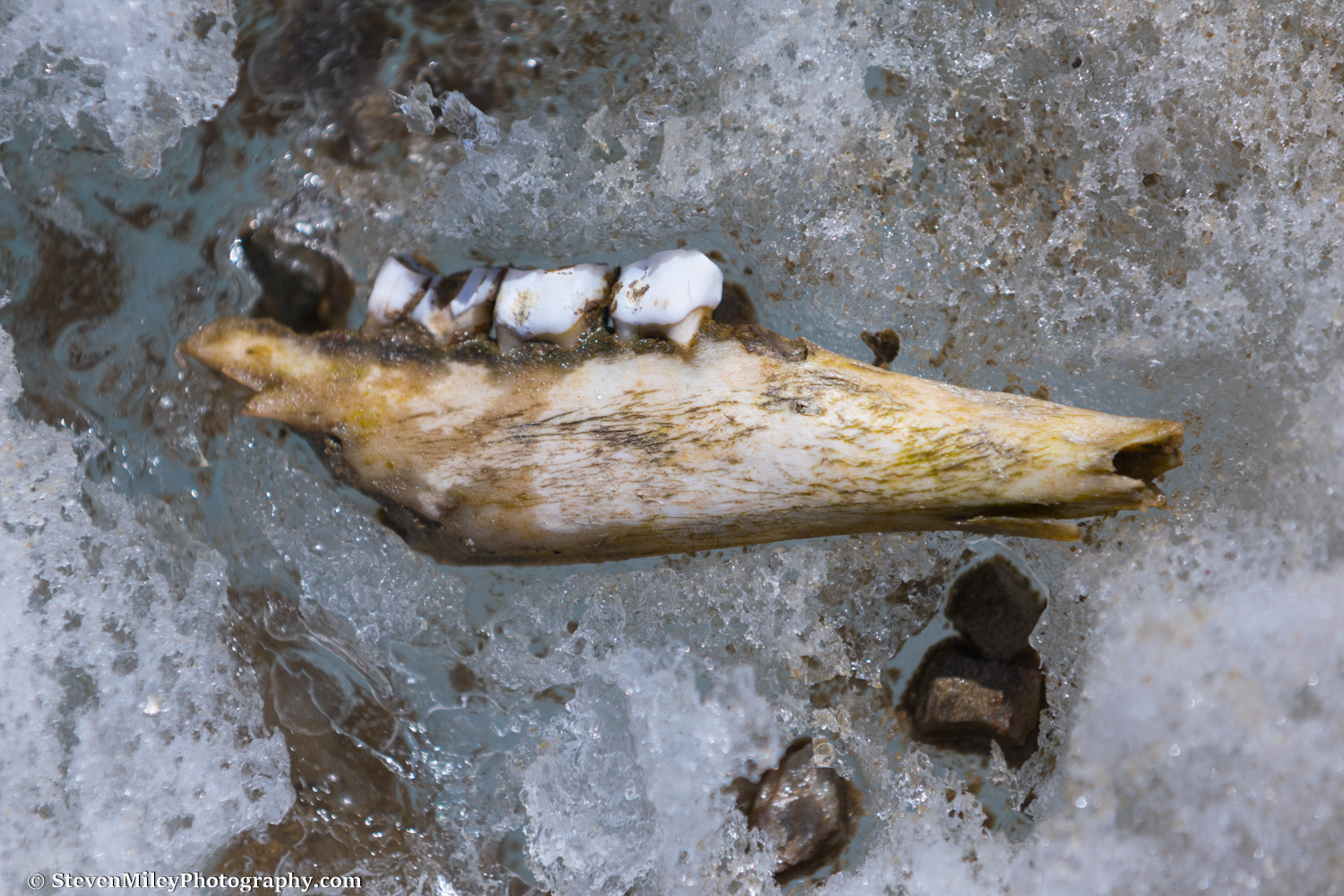
Part of a sheep jaw on the surface of Castner Glacier.

Part of a sheep jaw on the surface of Castner Glacier.

I continued all the way to the base of Mt. Silvertip. Thick slabs of blue ice spilled down its heavily-glaciated southern face, and impressive waterfalls poured over the cliffs at the mountain's base. I spied what I thought was a crevasse-free, walk-up route to the summit, but I wasn't about to climb on the mountain without a partner and a rope. Rock and ice completely surrounded me, but the sound of falling rocks and rushing water coming from all directions made the lifeless landscape feel quite alive. Though it was mid-June and the sun was shining bright, my fingers still went numb working the camera, and after I stopped to eat some cheese and a protein bar for lunch I had to start hiking quickly down the glacier to warm back up. I stopped to check out a waterfall spilling over a lingering sheet of ice on the east edge of the glacier, then laboriously hopped up boulders back to the hut. 

Rock and ice near "Item Peak" above the north branch of Castner Glacier.

Rock and ice near "Item Peak" above the north branch of Castner Glacier.

That night, after laying down and closing my eyes to go to sleep, I was startled by a sudden, loud rumble. Seconds later, the hut began shaking. Earthquake! 

Before I could react, the shaking stopped. Having spent most of my life in Florida, this was the first perceptible earthquake I had ever experienced and I had no idea at the time how strong it had been. I checked UAF's Alaska Earthquake Center website when I got home and saw it was only a 2.9 magnitude quake centered on the nearby Canwell Glacier just five miles away. I visited the Lower Canwell Hut a month prior, and I imagine the shaking would have been a bit stronger over there. 

The next morning was rather cloudy, but I saw some patches of blue sky further up the eastern "White Princess" branch of Castner Glacier and decided to explore in that direction. I avoided the muddy slope I climbed on the night of my arrival and instead traversed over lower angle rock past the crevasse field on the hut's south side. A few Dall sheep ewes were grazing on the slope and they quickly retreated to nearby cliffs when they saw me, where they cautiously watched me until I was at least a quarter-mile away.

As soon as I reached bare ice, I encountered two circular snow patches on the glacier next to each other. Streams flowed into both of them but no streams came out the other side, a sure sign that moulins were lurking underneath. Moulins are deep, vertical shafts leading straight into the dark interior of a glacier, and most are wide enough for a person to fall through and some are big enough for a car to easily fit inside. I widened a small hole in the snow covering one of them and tossed some large rocks in, listening for several seconds until each one crashed against the ice in the darkness below.  

One of the narrow crevasses I hopped across on the White Princess branch of Castner Glacier. Black Cap is in the background.

One of the narrow crevasses I hopped across on the White Princess branch of Castner Glacier. Black Cap is in the background.

Farther ahead, I encountered a very narrow crevasse that ran across the entire half-mile width of the glacier. The dozens of streams running down the glacier's surface emptied into the crevasse and their collective echo sounded like a roaring waterfall even though most of the streams were barely more than a trickle. I stepped over the crevasse and continued up the ice until it became mostly covered in snow, then started walking along the bare rock of the lateral moraine. An actual roaring waterfall was carving away at the side of the glacier in one spot, and just beyond it the glacier cascaded down in a series of jagged blue walls as its slope abruptly increased. Several small crevasses began appearing on the moraine as I neared the O'Brien Icefall at the head of the valley, and I hopped over them or walked circuitous paths around them. I stayed on exposed rock as long as I could, but the crevasses became completely covered under weak snow bridges and I eventually had to stop when crossing snow became the only way forward. 

I had a clear view of Black Cap but, disappointingly, I hadn't gone quite far enough to see White Princess around the bend in the valley. As I took pictures, two jets from Eielson Air Force Base painted twisting contrails in the sky over the O'Brien Icefall and blasted out a pair of sonic booms, almost as if they were putting on a private air show for me. I expect by July it would be easy to hike all the way to the base of the icefall without having to worry about hidden crevasses, and a nearby hill would provide an amazing place to camp.  

The O'Brien Icefall.

The O'Brien Icefall.

On the return, I climbed up to the hut the same way I had descended and found it to be much easier and safer than the other two routes I tried. Drizzling rain fell the rest of the evening, but the sun peeked through the clouds just before falling behind Mt. Silvertip and I was able to snag a couple shots of the front of the hut in direct sunlight, a rarity because the sun is either behind the hut or blocked by mountains most of the day. I scanned the lower glacier for people and animals, but everything was quiet below. Four straight days of unusually great summer weather in the valley and I was the only one around to enjoy it.

The view climbing up "the easy way" to the Thayer Hut from Castner Glacier.

The view climbing up "the easy way" to the Thayer Hut from Castner Glacier.

On my final morning at the hut, I washed dishes, packed up my gear, swept the floor and wrote an entry in the log. I had gotten used to life at the hut and told myself next time I would bring more food so I could stay for an entire week or two. I measured the elevation of the hut using my InReach and found it sat around 4950 feet, a little higher than the 4800 feet quoted by the Alaska Alpine Club. I descended to the glacier below via a steep scree slope on the southwest corner of the meadow, and while it wasn't too bad going down, the footing was much too loose for me to consider going up that way in the future. I measured the elevation at the glacier to be around 4300 feet. No wonder it takes the better part of an hour to climb up to the hut. 

Even though my pack was ten pounds lighter and I was heading slightly downhill, the return trip took just as long as the forward journey since I was in no rush to leave. I stumbled upon two rock ptarmigan nests camouflaged on the glacier moraine, and both times the adorable flightless chicks peeped as they waddled away from me in multiple directions while the mother tried to get me to chase after her. The final mile to the glacier's terminus is always the toughest because the terrain is so hilly and the thin layer of soil and rock covering the ice tends to slide out from underfoot on relatively gentle inclines, and this time was no exception. I finally crested the last hill and stood looking down at the swift, turbulent water of Castner Creek below, and from there it was simply a matter of walking a short distance along the unmarked trail beside the creek back to my car. As I rounded Donnelly Dome on the drive home, I glanced to the south at Mt. Silvertip glowing in the golden evening sun, and I knew Thayer Hut was sitting empty on the other side. I hope it doesn't stay empty for long.
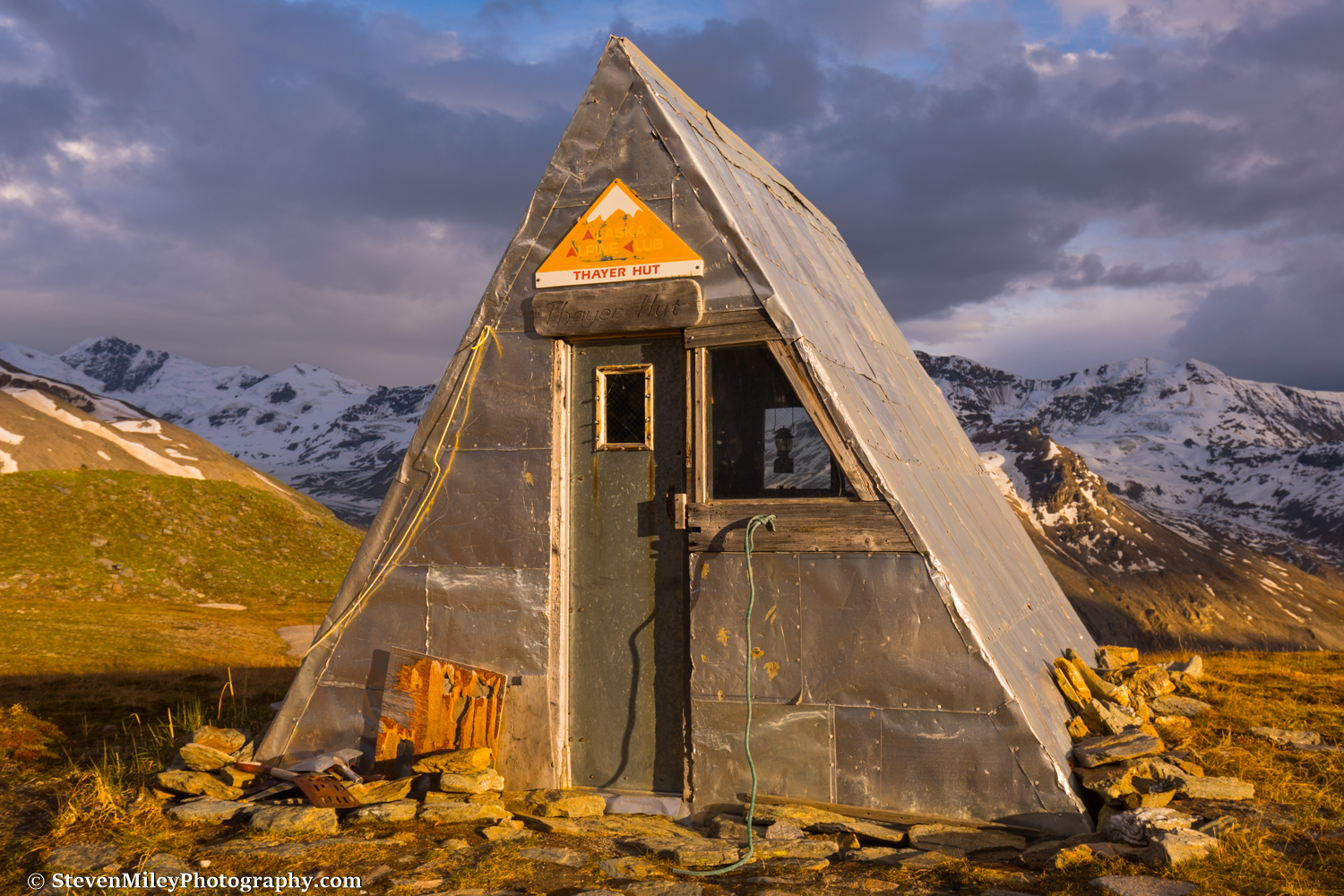
The Thayer Hut in the evening sun with the familiar lantern hanging in the window.

The Thayer Hut in the evening sun with the familiar lantern hanging in the window.

Interested in exploring Castner Glacier? Check out my Black Rapids Tours offerings.
 

The Buses of Denali National Park

 
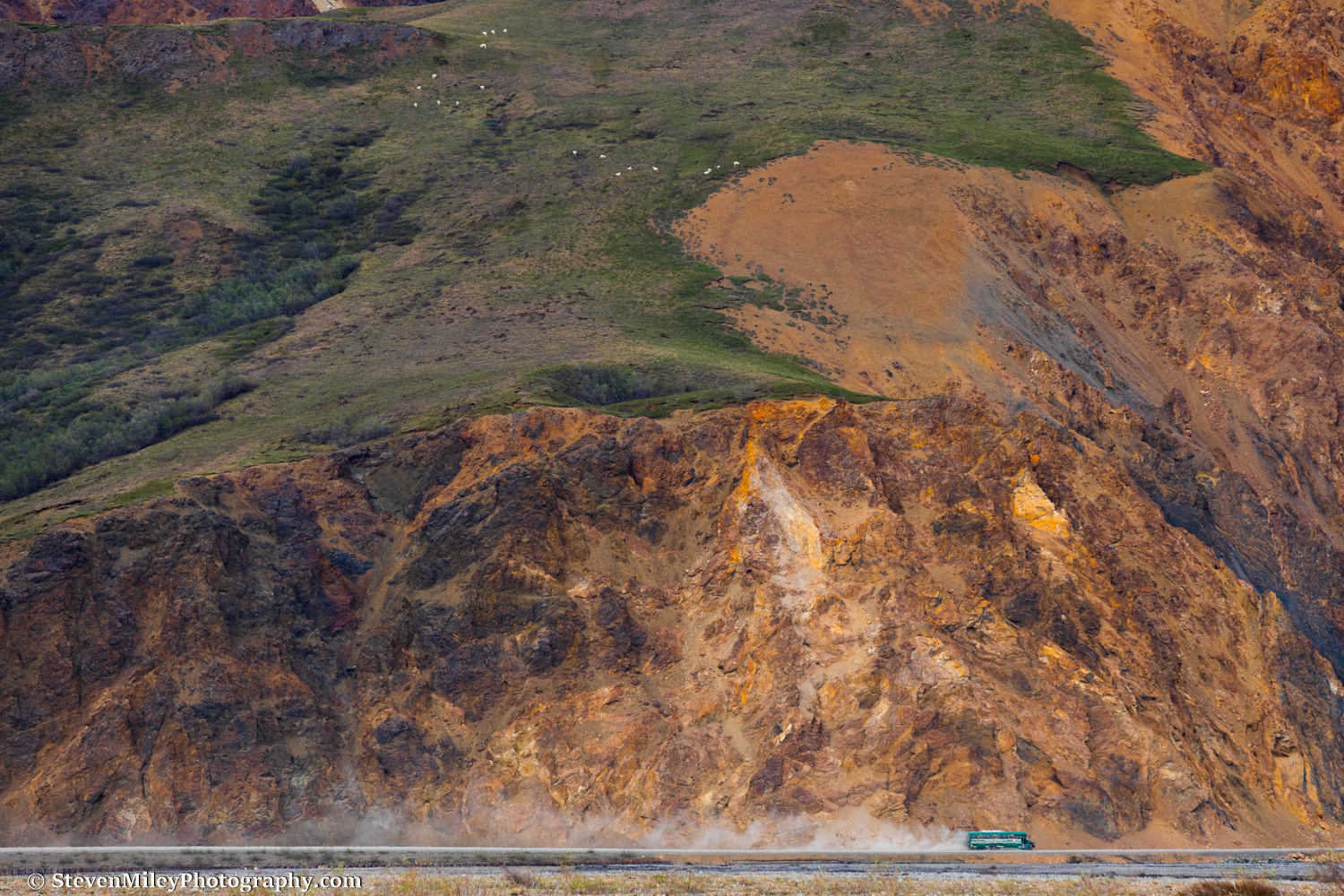
A shuttle bus passes a band of Dall sheep at the base of Polychrome Mountain in Denali National Park.

A shuttle bus passes a band of Dall sheep at the base of Polychrome Mountain in Denali National Park.

“Would you like a banana?” The woman leaned over me, a look of concern on her face. I was sitting beside my backpack at the Polychrome Overlook waiting on a green shuttle bus, drying my hiking boots and socks in the early morning sun and trying to relax after spending the night on top of a nearby ridge. A tan tour bus had just rolled up to the overlook, suddenly shattering my sense of solitude as dozens of gawking tourists emptied from it.  

“No, thanks. I’m fine.” Cranky from lack of sleep and feeling somewhat insulted by her worry that I was starving, I struggled to remain polite. The other tourists stared at me astonished like I was the first grizzly bear they saw in the park. Several people asked me what I was doing at the stop, and most of them were surprised to learn the park allowed backcountry camping—or that anyone would camp in the park’s backcountry—when I told them. As the passengers began reloading, another woman said to her husband, “Wait, let me get a picture of the camper!” Smiling giddily, she shoved her phone in my face and took a picture. I’m sure I wasn’t smiling.

Two more tan buses arrived soon after, and I immediately pointed to a cluster of Dall sheep on a nearby hillside when the passengers approached to keep them from bothering me. Finally, a green bus arrived and I climbed aboard, anxious to get to my next destination.

Park visitors at the Polychrome Overlook.

Park visitors at the Polychrome Overlook.

Private vehicles are not allowed beyond mile 15 of Denali National Park’s road in the summer without a special permit. Instead, a bus transit system is used to convey people throughout the park. There are two types of buses: green shuttle buses, which provide passengers the flexibility to stop and enjoy the wilderness at their leisure, and tan tour buses, which provide passengers a narrated tour at considerably higher cost but offer them no opportunity to explore the park on foot. The tan buses are filled with casual tourists, many of them fresh off a cruise ship or the train and simply checking a box off their Alaska sightseeing itinerary. The green buses carry some of the same people, but also some who plan to camp, hike, bike, or just sit and enjoy nature for a while during their time in the park. There are also “camper buses”, green shuttle buses specially modified to accommodate camping gear for people staying at a campground inside the park or in the backcountry. Not only are camper bus tickets the cheapest, but they also allow the holder to ride anywhere in the park on any green bus for seven days.

Camper buses rarely fill to capacity, but the measly three passengers on my initial bus ride into the park seemed pitifully few. The other two passengers were twenty-something brothers from Iowa who were visiting Alaska for the first time and camping in the backcountry as well. Before we reached the Savage River, our driver stopped to pick up two park rangers. The rangers and bus drivers typically know each other well, and one of the rangers seemed surprised that our driver was piloting a camper bus, asking if he would be doing so all summer. “No, I don’t have that kind of seniority,” said the driver. I asked them what made the camper bus special, fairly certain I knew the answer. The driver, careful not to sound disparaging, politely responded, “The clientele is better.”     

Exploring the backcountry of Denali National Park in early summer.

Exploring the backcountry of Denali National Park in early summer.

While the permitting process required to stay overnight in the park’s backcountry is slightly cumbersome and the bus ride into the park can be painfully slow, it is refreshing to interface with park rangers, bus drivers, and other backpackers who share the same incurable urge to be out there. On the other hand, it's disappointing to see the majority of park visitors taking only a superficial glance at the wilderness from a bus window. I can only imagine what it must be like dealing with some of the more oblivious tourists on a daily basis—like the one I overheard telling a bus driver she was worried because a couple of arctic ground squirrels appeared to be fighting each other. I wonder how she would have felt if she saw a grizzly bear swallow one whole. 

One of the park rangers had extensive experience in the park’s backcountry, and he helped answer some of my questions about the terrain I was planning to explore on my current trip and a future trip to Peters Glacier. When I mentioned Peters Glacier, I could see the gleam in his eye.

“That unit is definitely underappreciated,” he said, referring to the management units into which the park’s backcountry is divided. As a photographer and hiker, I’m uninterested in competing with the thousands of perfect photographs of Denali taken from the vicinity of Wonder Lake, especially when there’s an infinite number of unique views available from the backcountry where I can also have fun exploring. Peters Glacier runs directly beneath the imposing Wickersham Wall of Denali, and I’ve become convinced there isn’t a better place to stand if you want to sense the full immensity of the mountain, besides perhaps the summit itself.

The park rangers exited near the Teklanika River rest stop, where the other passengers and I saw a bear ambling along the river. The afternoon sun was beginning to bake the bus interior, so I was happy to escape it when the driver dropped me off at a drainage on the east end of Polychrome Mountain. After a minute or two of hiking, the road was out of sight and I heard only the sound of rushing water in the creek beside me. After an hour, I reached a pass where hills, creeks, and ridges led off in every direction with no sign of humans in sight. I picked a ridge to climb that would provide a good view of Denali and the sunset, then followed Dall sheep tracks to the top while skirting around the patchy snow still lingering on the ridge.

When I topped out on the main ridgeline of Polychrome Mountain, the park road came into view again far below. A tiny bus passed by, heading east toward the park entrance and civilization. A Dall sheep ewe sitting a hundred yards away down the ridgeline calmly watched me while I retrieved my camera gear from my pack. In the other direction, about a half-dozen sheep casually defied gravity as they grazed on cliffs just a stone's throw away. Denali was shining brilliantly in the warm light of early sunset—surely it had been a summit day for some fortunate mountain climbers. I photographed until the light faded and the temperature dropped below freezing.   

Silhouetted self-portrait on the ridgeline of Polychrome Mountain.

Silhouetted self-portrait on the ridgeline of Polychrome Mountain.

I thought about climbing down the ridge after sunset and camping low where I would be warmer and more comfortable, but I wanted to see the alpenglow on Denali at sunrise, which was only a few hours away. Instead, I crawled into my sleeping bag and curled up against my backpack, dozing above a small snow ledge that provided safety against rolling down the steep scree slope below while I listened to music on my headphones. It felt about as comfortable as a coach middle seat on a three-hour plane ride, except my toes were also cold. After little more than an hour, the evening twilight morphed into morning twilight, skipping over the dark of night. Before I knew it, Denali was beginning to glow again with the pink light of dawn. Tired, cold, and hungry, I worked the camera for a short time, then hiked down to the pass below where I left my tent and food cache. 

Morning alpenglow on Denali.

Morning alpenglow on Denali.

On the way down, new ice covered the small streams trickling down the ridge, and the muddy ground I encountered on the way up had frozen solid. When I reached the pass, I stopped to eat breakfast, then followed my footprints back to the road where I ate a second breakfast, brushed my teeth, and watched a few caribou grazing on the tundra for a while. The first bus wouldn't arrive for another two or three hours, so I decided to kill time by walking to the Polychrome Overlook, where I waited in peace until the aforementioned tour buses arrived. 

After I boarded a green bus, the driver stopped a few miles down the road to pick up a group of four backpackers. Two of them sat next to me and we swapped hiking stories. Like me, they were Alaskans taking advantage of the unusually clear weather in the park. We laughed at our ostentatious bus driver, who dramatically retold the park's history and shared elaborate accounts of his past wildlife sightings of wolverines and marmots while the tourists oohed and ahhed. Maybe he used to drive a tan bus.    

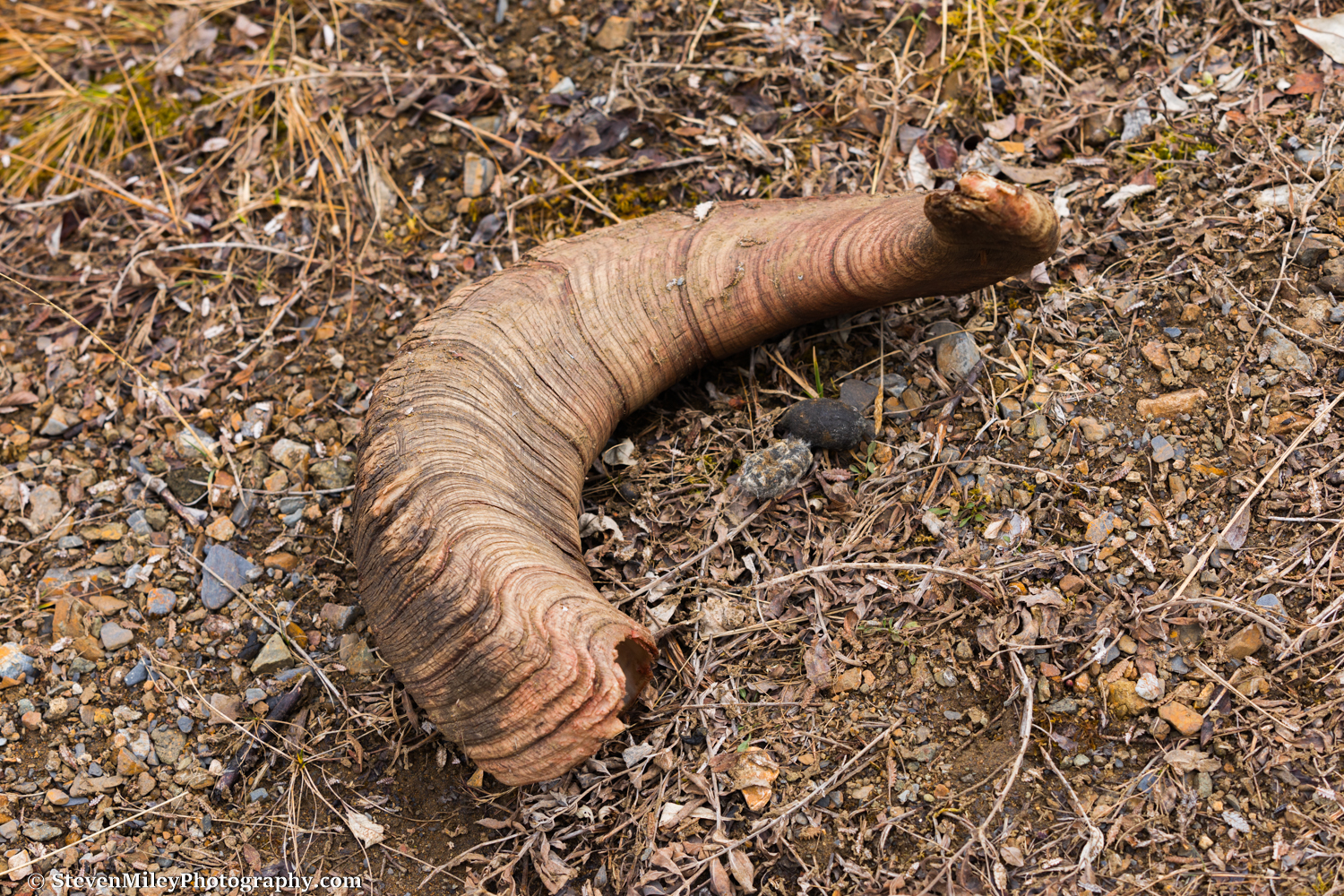
I had hoped to climb Gravel Mountain next and perhaps cross a pass from there into the Toklat River valley, but that was out of the question due to the snow still blanketing the higher elevations from a late May storm. (Or, rather, due to me being unequipped for snow travel.) Instead, I disembarked at a drainage just east of Stony Creek and went looking for a good place to camp since I was pushing 36 hours without sleep. The drainage narrowed into a small valley, where I found a sheep horn laying next to the creek. Looking up I saw sheep trails crisscrossing the mountainsides, and looking around I saw caribou trails crisscrossing the tundra. I hiked to a short pass leading to a neighboring drainage and found a perfect spot to place my tent. I buried my food cache in the snow to keep the sun from melting the Snickers bars inside and immediately went to sleep.  

Sheep horn in a small drainage adjacent to Stony Creek.

Sheep horn in a small drainage adjacent to Stony Creek.

The next morning, I awoke to an odd sound. Mmph. Mmph. Still not fully alert, it took a few moments until I realized there was an animal outside my tent. I instantly sprang up, worried it might be a bear. However, after listening for a few seconds, I recognized it as the vocalization female caribou make to stay in touch with their calves. Sticking my head outside the tent, I saw a couple dozen caribou grazing just a few yards away. As soon as they noticed me, they scattered into the valley below. That’s certainly not an experience you’ll get riding the bus, I thought to myself.

Before heading back to the park road, I hiked up Stony Dome to get a view of Denali. From the top, I saw Stony Pass below, where a tan bus was stopped so passengers could take photos of the mountain. In the other direction I saw Highway Pass, with a couple buses spewing dust along the road’s length in between. I looked up at the summit of Denali, wondering if it was possible to the see the park road from there. I suspect it is, but at least you wouldn't be able to hear the incessant buzzing of the buses.

A bus leaves a trail of dust after departing Stony Pass.

A bus leaves a trail of dust after departing Stony Pass.

I hiked back down and stopped to retrieve the gear I left at the bottom. When I finished repacking, I looked up to see a group of nearly 100 caribou cows and calves descending the hillside directly across Stony Creek. They crossed the creek and proceeded up the hillside less than a few dozen yards to my left. I photographed them as they plodded by, careful to avoid making my presence known. After they disappeared from view, I thought, “That’s another experience you won’t get riding the bus.”    

Caribou crossing Stony Creek.

Caribou crossing Stony Creek.

I walked to the Stony Creek bridge and waited until a camper bus arrived. Its only passengers were two mountain climbers fresh from an attempt on Denali’s West Buttress. They both spoke with heavy European accents and had old frostbite scars on their faces. One of them was a mountain guide and said his team never made it beyond 13,500 feet due to bad weather. They had camped in the park the previous night and were looking for another place to explore, and I pointed out some areas I thought they might enjoy as we rode to the Eielson Visitor Center together. The rangers there were discussing reopening the Eielson Alpine Trail, which had been closed earlier in the day after some hikers encountered a grizzly bear sow with cubs. I received a weather update, ate lunch, refilled my water bladder, and scoped out the terrain on the far side of the river for a potential future trip, while the mountain climbers studied the ridges of Denali, which was mostly visible despite heavy cloud cover.

We reboarded the bus along with some additional passengers who were heading back to the park entrance after hiking around the visitor center. The mountain climbers disembarked near the same place I camped the previous day, while I disembarked near the west branch of the Toklat River. I felt self-conscious as I unloaded my gear through the back of the bus, knowing the other passengers were all waiting on me. As I closed the back door, a woman sitting near the back smiled and said, "Have fun."

"I will." The bus pulled away slowly. Like flipping a switch, I was back in the wild again.

I donned my backpack and bushwhacked to the edge of the Toklat River. After a short walk upstream I was stopped by a large creek flowing into the river from the west. I found a braided spot and crossed the creek without getting my feet wet, then started following a social trail beside the river, which was also clearly used as a game trail by wildlife. A few caribou watched me hesitantly from the gravel bar as I passed them. Light rain was falling across the river, where a rainbow appeared every so often as the sun peeked through the clouds. Glancing behind me, I saw a bus chugging along beneath a band of sheep grazing on a patch of green hillside. It took several miles of walking before the road finally fell out of sight. After that, I found a soft, mostly dry bed of silt along the gravel bar and decided to make camp so I could reduce the weight of my pack for my push to the glacier at the head of the valley the next day. 

As I began to set up my tent, I saw movement in the brush along the bank of the river just a couple hundred feet upstream. My initial reaction was "bear", but it turned out to be an off-duty park ranger on the way back from a day hike to the same glacier I planned to visit.

“I’m trying to hit 300 miles in the backcountry this summer," he said. "Today was an 18-miler.” He related how he inadvertently wound up in the middle of a grizzly bear sow chasing off its cub at one point, and how he saw another sow with two cubs that he recognized from earlier in the spring. 

“I love this park. Where else can you hang out with the bears?” he said as he started walking away against the backdrop of Polychrome Mountain. 

The park ranger I met along the Toklat River.

The park ranger I met along the Toklat River.

I didn’t expect to see anyone else that night. However, just before I crawled into my tent I saw a lone woman with a big backpack hiking upstream from the direction I had come. She was a college student from the lower 48 working in Seward for the summer who had come to the park on her first three-day weekend to go backpacking. She had caught the last available green bus to the Toklat River and started hiking after 8 p.m., which wasn't too late considering it wouldn't be dark in the park again until August. I told her I was planning to head to the glacier the next day and she said she would probably be heading that way but wasn't sure. She continued up the river to find a campsite, and I went to sleep.

The sun was rapidly burning off the clouds leftover from the night before as I started hiking upstream the next morning. The Toklat River valley is known for high winds, but there wasn't a breeze and I soon found myself shedding layers. Recent bear tracks on the gravel bar and the social trail paralleling it led in the same direction I was traveling, and I expected to encounter their owners eventually. Unlike other areas of the park still trapped in the shoulder season, the west side of the river valley had already turned a verdant green and most of the snow had disappeared. I passed several clear streams cascading down from the rocky ridges above which seemed etched on the stark blue sky. I also passed the college student's tent pitched on a grassy bench, but I couldn't tell if she was at her campsite or not.  

Grizzly bear tracks heading up the Toklat River.

Grizzly bear tracks heading up the Toklat River.

At one point, a bluff pinching against the river blocked my way forward. It could have easily been circumvented by sidling around the edge but I didn't realize that until too late. Instead, I found myself staring down over steep rock at the river below, wondering how I had scrambled to a spot where I couldn't safely backtrack and wishing I had a helmet before I maneuvered my way down a chimney to safety on the far side. Another pinch point further upstream didn't present as much difficulty. 

Occasionally, sheep and wolf tracks showed up on the trail next to the continuous bear tracks. I spied a couple groups of sheep on the hills above, but no bears or wolves. The heat emanating from the rocks on the gravel bar distorted the light as I scanned the valley floor ahead of me, just like looking down a desert highway on a hot, sunny day. Finally, a few golden objects appeared about a half-mile ahead. I couldn't clearly resolve the animals but they were unquestionably a grizzly bear sow and two cubs—surely the same ones the park ranger had told me about. I slowly walked forward until I could clearly see the animals. The sow seemed to look in my direction for a short moment and promptly went back to digging for roots. The river pinched against the east side of the valley in that spot, while a wide alluvial fan met the edge of the gravel bar on its west side. The bears were right in the middle, so I waited until they drifted close to the alluvial fan, then cautiously walked along the edge of the river past them. They didn’t bother to turn their heads. 

The river appeared to pinch against the west edge of the valley several times farther ahead, so I preemptively started looking for a spot to cross where I could avoid wading through the icy water. I found a slab of collapsed ice that bridged most of the main channel, and it appeared to be a popular sheep crossing based on the recent tracks covering it. While I wasn't sure the slab would stay put with my weight on it, I thought, "If it's good enough for the sheep, it's good enough for me," and hopped across without issue.

As I continued the last mile or two to the glacier, summer seemed to reverse into winter. It became decidedly cooler and I was forced to put on my jacket. The green hillsides gave way to bare, rocky slopes with plenty of snow up high. The gravel bar itself became completely covered under snowpack and I felt like I was walking on the moon as I covered the final distance to the unnamed glacier. Scott Peak finally came into view with its completely glaciated northern face towering at the head of the valley. Afternoon clouds had arrived and were ruining the light for photography, but the glacier itself was completely covered in rock and snow and rather unpicturesque, anyway.  

Freshwater meets a silty glacier stream near the headwaters of the west branch of the Toklat River. The debris-covered moraine of the unnamed glacier is running horizontal above the snow in the photo.

Freshwater meets a silty glacier stream near the headwaters of the west branch of the Toklat River. The debris-covered moraine of the unnamed glacier is running horizontal above the snow in the photo.

I didn't have much time to explore since it was my last day in the park and all the enticing places I wanted to go were at least an hour's detour, so I just ate lunch while I soaked in my bus-free surroundings. On the return, I unwittingly hiked past the location where I crossed the river earlier. The river eventually pinched against a steep hillside and I decided to try jumping across there rather than walking back upstream. I stepped onto the ice protruding over the river, testing it thoroughly with my trekking poles before putting my weight on it as I approached the edge. The river roared a couple feet below me and I couldn't see an inch below its surface. I didn’t want to go for an unplanned swim in the freezing water or break my leg on unseen rocks, so I carefully rehearsed the six-foot jump in my head and made sure my foot wasn't going to slip on the ice. I counted down from ten and leaped, landing gracefully among the rocks on the far side. I let out a triumphant yell, then looked behind me. My eyes widened as I saw just how thin the ice was that I had been standing on moments prior. Had I seen that first, I never would have attempted the jump, but I survived unscathed, nonetheless.  

The pinch points I encountered earlier were incredibly easy the second time around. I quickly passed both of them and the rest of the way was a breeze. The college student's tent was still in the same spot, and I wondered where she might have gone hiking since I didn't encounter her along the river. By the time I stopped to pick up the gear I left at my campsite, the sun had finally broken through the clouds again and the afternoon was turning into a scorcher. The creek I easily hopped across the day before had become impossible to jump due to the rapid melting of snow and ice, but by the time I reached it I didn't care much about walking in wet shoes and quickly trudged through it.

The more difficult pinch point along the western edge of the upper Toklat River.

The more difficult pinch point along the western edge of the upper Toklat River.

I bushwhacked the final length to the road and started walking toward the Toklat River rest stop. A tan bus passed me from behind and dusted me as it went by, only to stop a short distance ahead so the passengers could view sheep on Polychrome Mountain. I walked past the bus and received a second dusting when it started moving again. I was already covered in four days' worth of dust, dirt, silt, mud, sweat, crowberry stains, and perhaps a little blood, but I felt like the bus driver and passengers deserved to do my laundry after that slight.  

I flagged down a camper bus leaving the rest stop and climbed aboard. The bus was empty, so I struck up a conversation with the driver on the ride to the park entrance. He had been working in the park for decades and had seemingly hiked and climbed everywhere in it. He spoke in a gruff manner, befitting a wise old sourdough with seniority. I listened as he lamented some of the dying traditions of the park employees, including the waning popularity of the park's low-key half-marathon and the younger park rangers not spending as much time in the backcountry in their free time as they once did. He obviously loved the park—the real Denali National Park that provides endless opportunity to explore and the community behind it—and his disdain for those who failed to appreciate its greatness was fairly evident.

At one point, he became perturbed by another bus driver who had stopped along a cliff edge and seemed oblivious to our bus trying to pass—it was the same bus that had dusted me earlier. That started us talking about the different kinds of buses.

I said, “After the first time I rode the camper bus, I decided it’s the only bus I ever wanted to take into the park again.” He was not timid in offering his opinion.

“It’s the only bus a sane person would take. It’s the only bus a sane person would drive, if they can.”   

Unfortunately, it seems insanity is rampant within Denali National Park. The good news is it can be cured by changing your bus ticket.