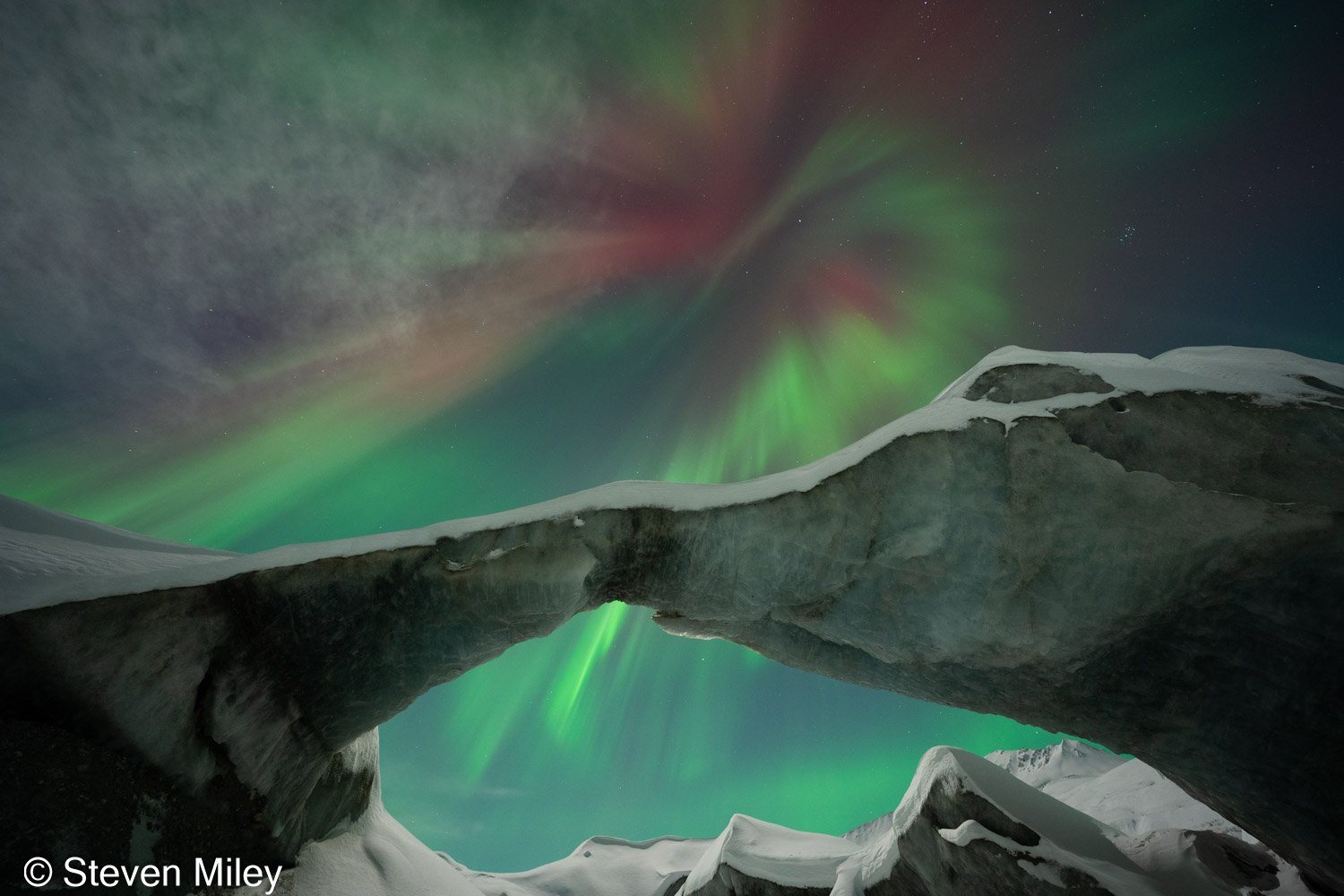
Canwell Glacier Aurora Expedition


Colorful aurora over an ice arch on Canwell Glacier.

On the night of November 30 - December 1, 2023, a rare combination of clear skies, strong aurora sparked by the direct hit of a coronal mass ejection (CME), a waxing gibbous moon, and a gap in my busy winter guiding schedule prompted me to plan my first backcountry aurora photo expedition in a couple years.

Early in the evening before the arrival of the CME, I started snowshoeing up Miller Creek toward Canwell Glacier utilizing a trail I had packed in the previous day. Models of the CME all agreed it would impact Earth around midnight Alaska time or shortly after, so I was mentally prepared to wait until 4am or later for the accompanying fireworks and planned to camp overnight at the glacier. With modest green aurora dancing through a gap in the clouds over the northern horizon, I cruised along the trail in the dark using a headlamp, flashing my light ahead periodically to check for moose. Luckily, I didn’t encounter any moose, but I did cross a set of fresh wolf tracks in the snow. The gentle hiss of water flowing in MIller Creek was the only sound.

While planning this expedition, one of my adventure buddies put me in contact with Shane, a friend of his from Fairbanks who also wanted to photograph the aurora in the mountains that night. I didn’t have a chance to meet Shane before I set out that night since he had a much longer drive, so he planned to catch up to me later following my trail. I estimated he would travel on skis about twice as fast as I would on snowshoes, so as I neared the glacier I started glancing behind me for a headlamp. I didn’t see him before I disappeared into the hilly terrain of the lower glacier, so I decided to leave him some notes in the snow indicating the time I passed by each spot.

I continued over a few steep hills to an area where I had found stunning ice caves in previous winters, breaking trail through pristine snow with the bright moon providing all the light I needed. As I topped one of the hills, I was surprised to see another track crossing the glacier in front of me, almost certainly left by a group of Dall sheep. After topping the last hill, I spotted a tall, thin arch of ice that would make the perfect foreground for my aurora photos.

Shortly after I began fishing my camera equipment out of my pack, I heard the sound of clacking skis echoing around the surrounding hills. Shane popped over the final hill a couple minutes later and sidestepped down to meet me just before midnight. We barely had time for an introduction before the aurora began to dance vibrantly across the sky and we both went to work photographing. I had no cell service to check the solar wind data, but the CME clearly hit right on schedule. Strong, naked-eye red auroras appeared in several patches of sky over the next few hours accompanied by swirling green. After the aurora finally subsided around 4am, I crawled into a nook under some overhanging ice nearby and nestled into my sleeping bag. The ambient temperature had dropped sharply, but the small space was insulated by the surrounding snow and ice of the glacier, which helped to keep me modestly warm.

Shane returned to the highway that night after dozing for only a short time. I woke up close to sunrise, tossed off my frosty sleeping bag and slipped on my boots and snowshoes, then wandered up the glacier to help my body warm up while looking for more ice caves. I found plenty of awesome sights, but didn’t bother to bring my camera. I returned to my campsite, packed up, and strolled back to the highway, marveling at the new frost on the landscape glinting in the morning sun.

My favorite shot from that night (located at the top of this post) became the December photo for the Greatland Graphics 2026 Aurora Calendar. I included some of my other best shots from that night below.
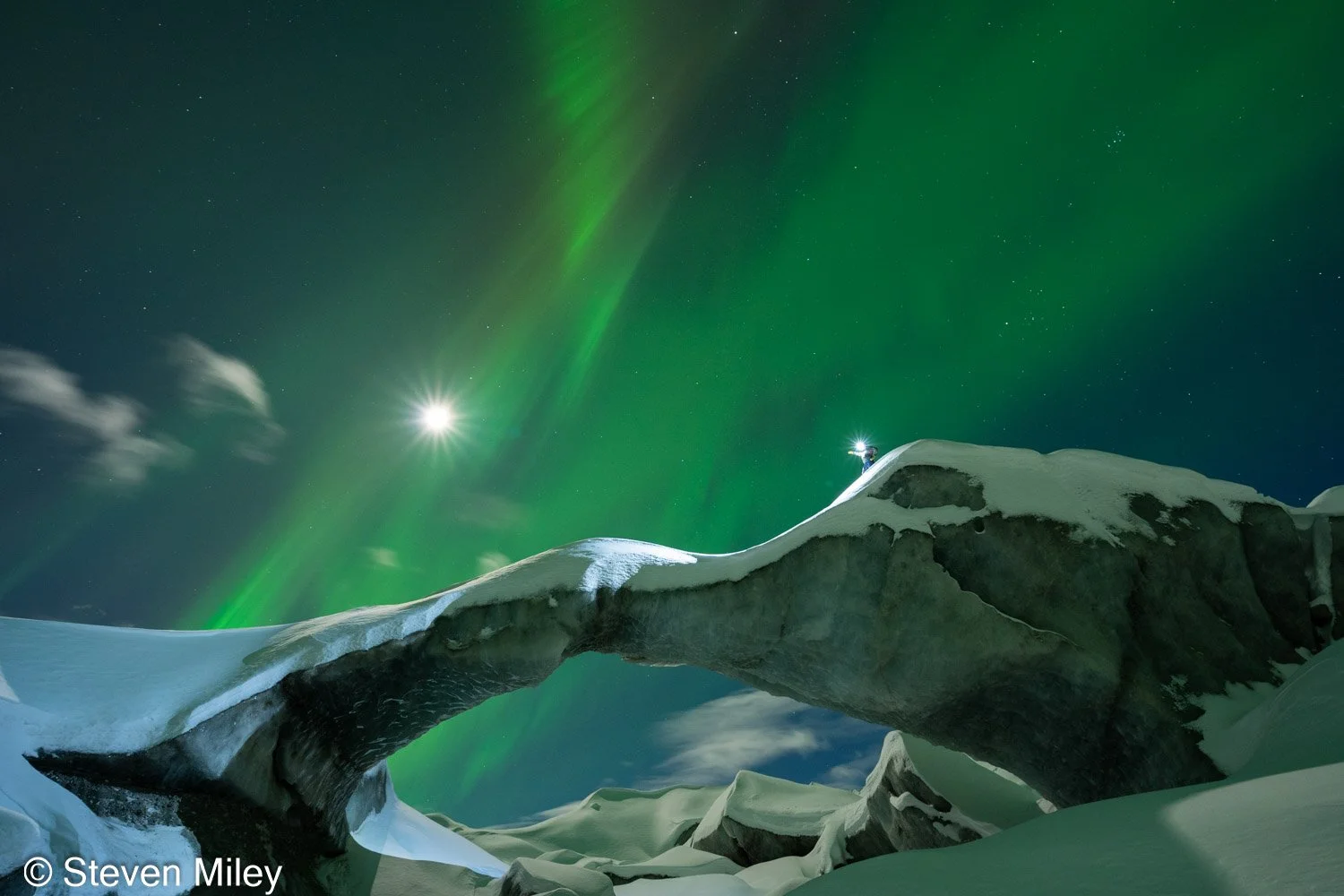
Shane poses with his headlamp on top of the ice arch opposite the bright moon.
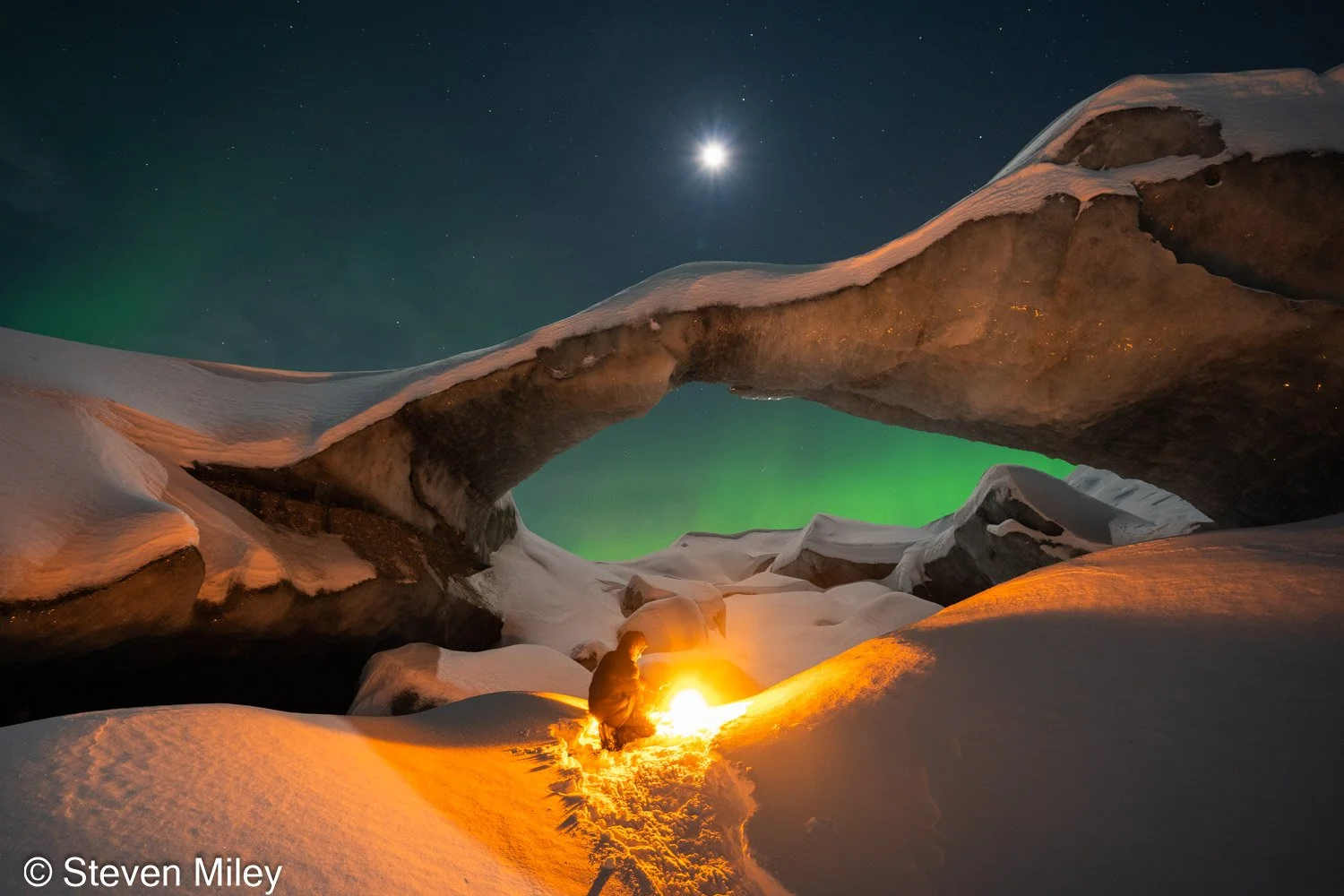
I brought some firewood to use for photos (and to warm my hands while photographing) but the aurora went into a lull after I finally succeeded in lighting a fire.
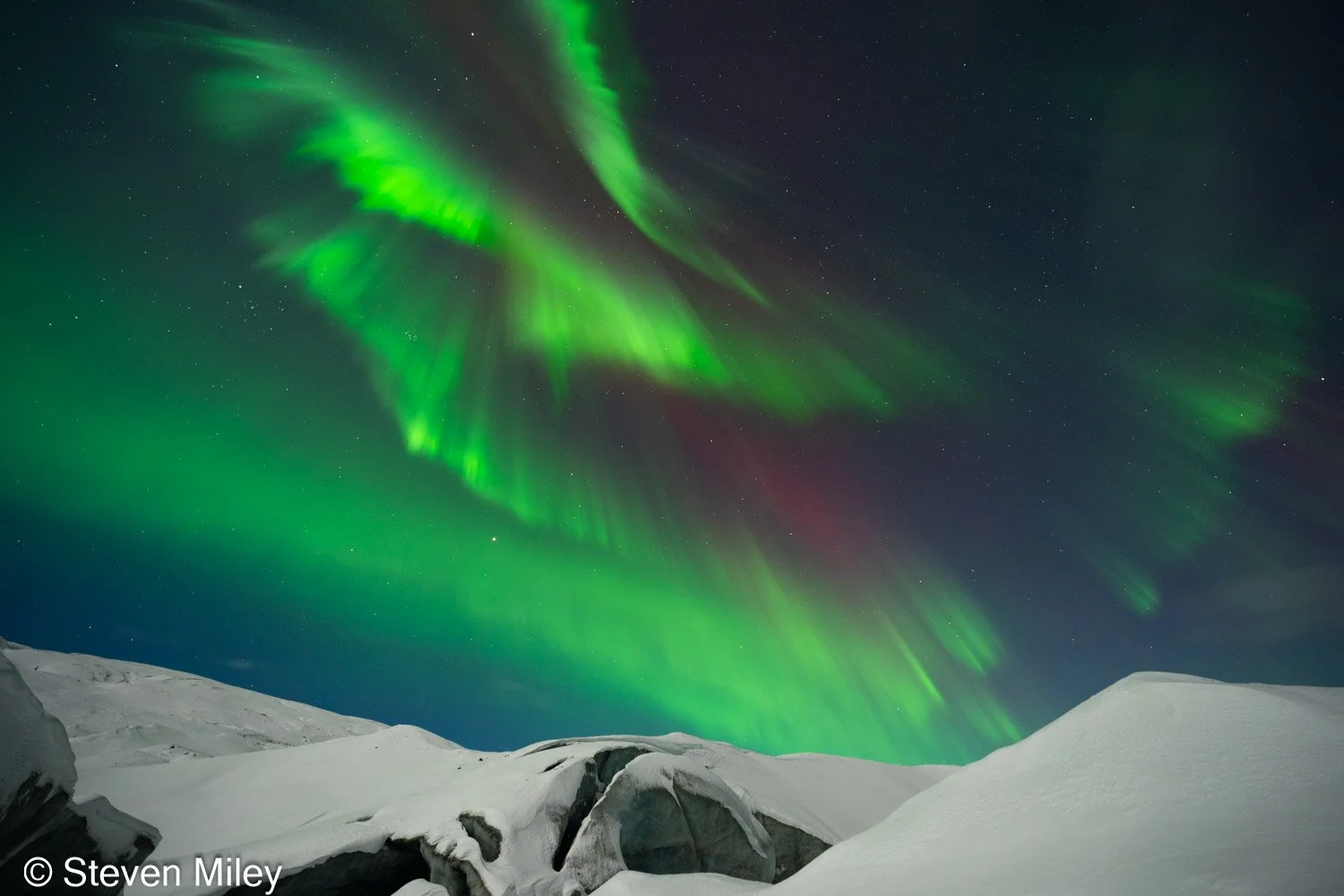
Bright aurora dancing over the snowy hills on the glacier.
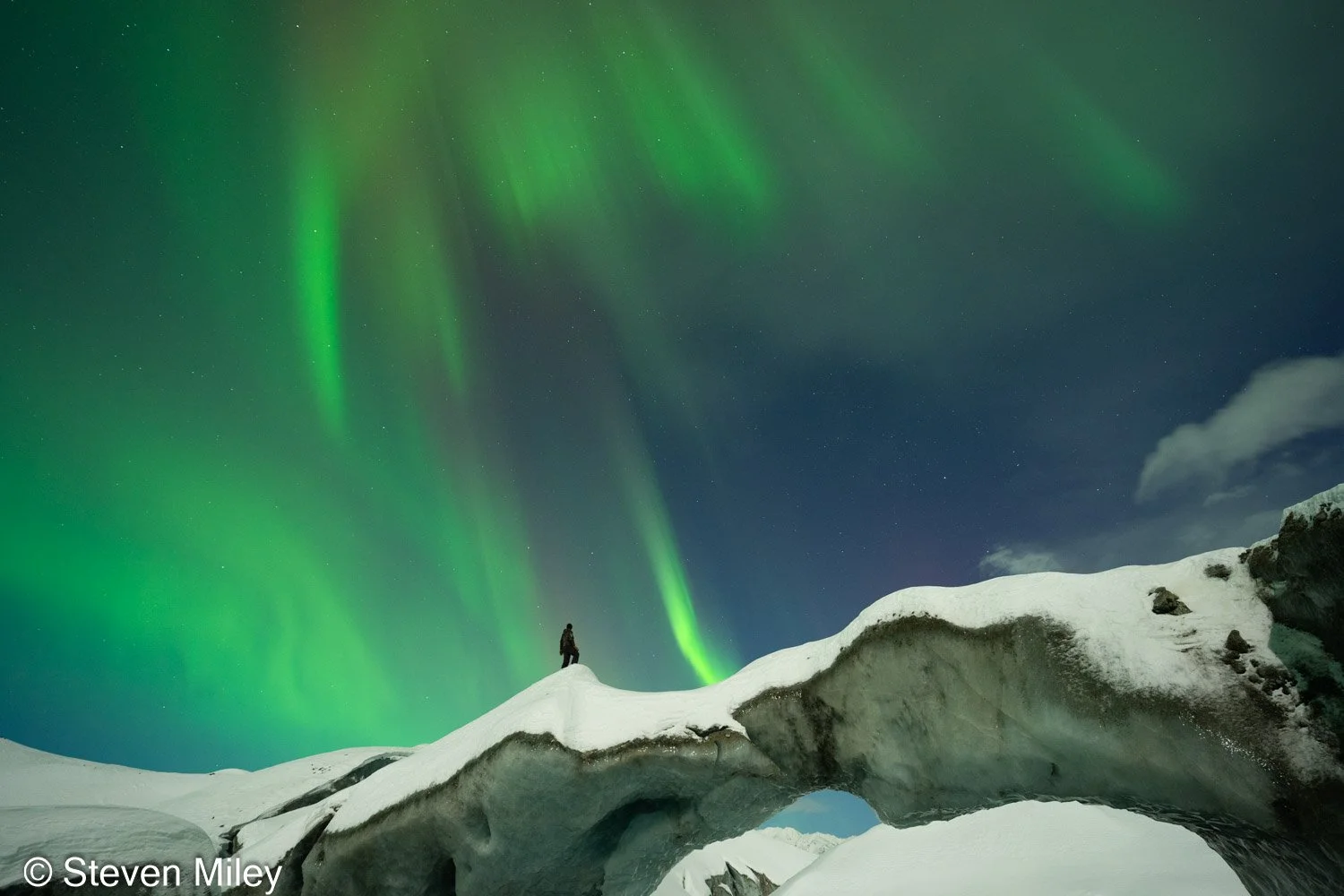
Shane silhouetted on top of the ice arch.

 

Tazlina Glacier


Ice version of the Rolling Stones logo?

Tazlina Glacier is one of the largest glaciers in the Chugach Mountains and all of Alaska by land area covered, but if you search online you won’t find more than a handful of non-aerial images of the glacier. The wide face of the glacier calves into a pro-glacial lake (which I’ll refer to as “Tazlina Glacier Lake”) connected via a 1-mile long outlet to the vast Tazlina Lake. Huge icebergs drift around Tazlina Glacier Lake in the summer and become trapped in the lake ice during winter. I first became aware of the glacier while scrolling across Alaska in Google Earth, and it beckoned to me every time I caught a brief glimpse of it from over 20 miles away along the Glenn Highway for over a decade. I originally thought I would visit the glacier with my pack raft in the summer, but hiking in from the road would probably be the most boring slog I’ve ever done. Visiting the glacier in winter hadn’t occurred to me until last spring when I realized conditions would be perfect for navigating the lake without concern for an iceberg rollover or major calving event flipping my raft.

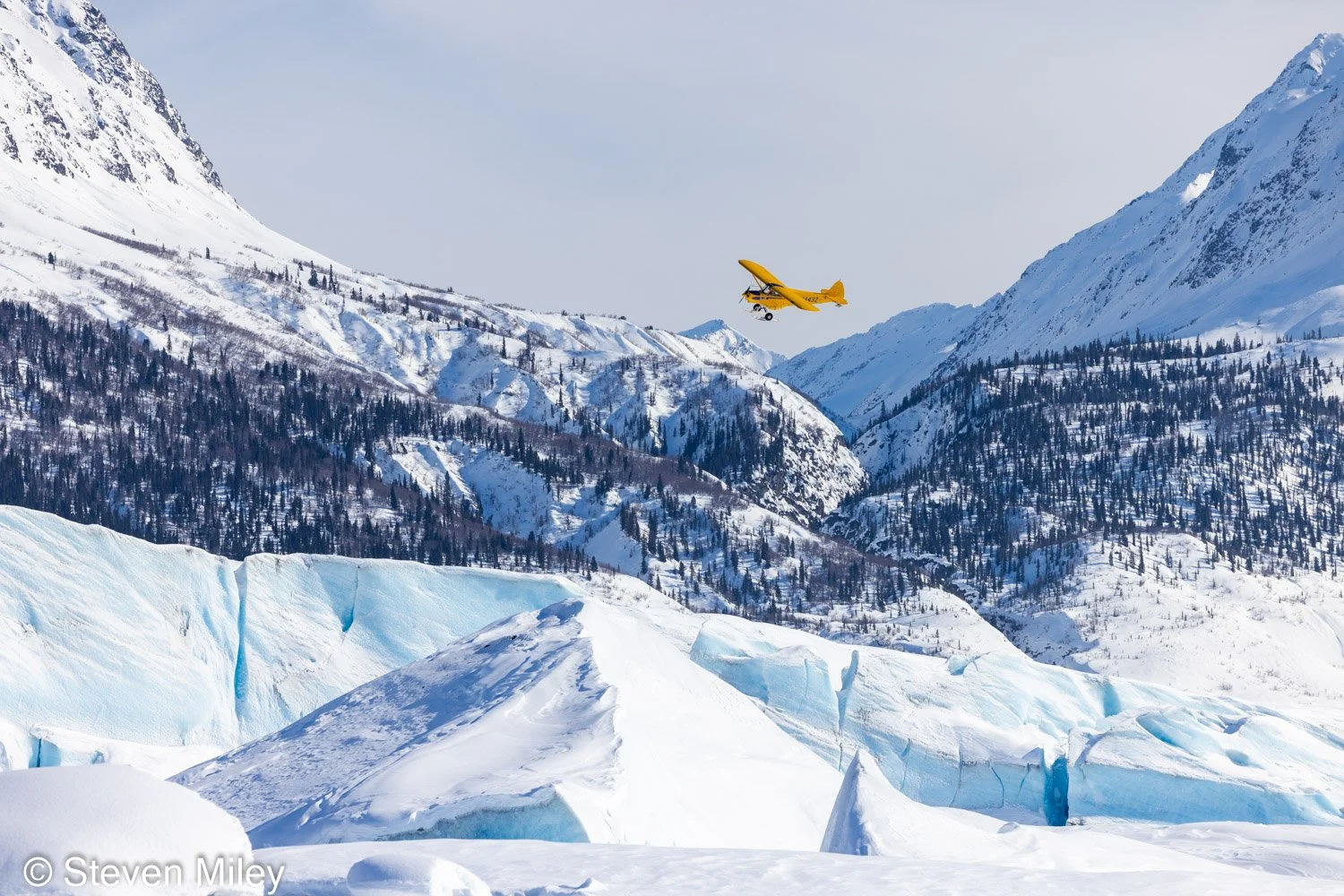
A perfect weather window materialized for an overnight trip to Tazlina Glacier during a few days I had set aside near the end of my busy tour guiding season in mid-April. The aurora forecast also looked promising, so I contacted Meekin’s Air Service to arrange a fly-in trip via Super Cub. My friends Phillip Wilson and Mary Webb came along, shouldering camp gear and serving as models.

The pilot executing a flyby over the glacier after the last dropoff.

We flew into the head of Tazlina Lake one-at-a-time in the Super Cub. I landed first and snowshoed just shy of four miles to the glacier terminus where serrated blue towers of ice loomed above the glacier lake. Mary and Phillip would take 2 or 3 hours to catch up, so I dropped most of my gear near a tall iceberg and went scouting with my camera.

Near the face of the glacier lie chunks of toppled ice and larger icebergs recently calved off the glacier. The movement of the glacier and presumably a few large calving events throughout the winter have broken and pushed up the lake ice in an obvious curve several hundred feet in front of the glacier face.

The glacier appeared motionless and stable, but the numerous chunks of ice scattered in front of its face had clearly toppled off the glacier throughout the winter, and the lake ice had also been forced upward by the movement of the glacier along a contour a few hundred feet in front of the face. Melt from the afternoon sun pooled up along this curve and around the bases of the icebergs, and only in these spots could I see the ice of the lake, which was otherwise covered in windblown snow. Earlier in the winter the lake would be mostly or totally clear of snow, similar to the Black Rapids Glacier pro-glacial lake that I visit frequently, and I suspect some years it’s mostly clear later in winter given the right weather. Experiencing prime skating conditions on the lake would be amazing.

Tazlina Glacier.

After photographing around the face of the glacier, I found three impressive ice caves in three separate massive icebergs within a few minutes’ walk of each other. All three ice caves contained incredibly blue ice, and two of them glowed partially. A huge shelf of ice had collapsed off the ceiling in one of the caves, and atop this shelf the entire cave glowed a deep, mesmerizing blue color. There was no debris to see in the ice, no cracks, and no gradation in the color—just a featureless, disorienting navy blue glow permeating the whole chamber like a black light illuminating an empty white room.

One of the other ice caves formed a curving tunnel from the top of the iceberg to the bottom. The bottom entrance was quite photogenic and I took my favorite photo of the trip there.

One of several ice caves found in some of the larger icebergs in Tazlina Glacier Lake.

I found the remaining ice cave after climbing atop a very large iceberg to scan the area nearby. Surprisingly, there was a large cave opening on top of the iceberg leading down a steep incline into a glowing chamber at the bottom.

After climbing atop another nearby iceberg, I spotted Phillip skiing across the lake toward the rendezvous spot. I returned there to find Mary already waiting where I left my gear, resting after arriving 15 or 20 minutes earlier. Phillip skied in with a large backpack on his back and another large bag slung over his chest and stomach, and Mary brought her own pack, too. I’m not sure why they brought so much junk for an overnight trip, but I guess it was good exercise.

Tall iceberg and campsite. Would have been awesome to catch some aurora from this spot.

We ate dinner as golden hour set in, then set off to explore the ice caves. Sunset wasn’t particularly impressive that evening since the mountains to the west obstructed most of the late evening sun in the glacier valley. We returned to camp under twilight and settled into our sleeping bags as darkness set in, sans tent. I spent a couple hours disappointedly watching solar wind measurements as they indicated the expected great aurora show that night would not be happening, then fell asleep. Oh well, maybe next time.

Mary skies in front of an ice cave at sunset.

The next morning I rose before my companions and walked about a mile to investigate the icebergs at the other end of Tazlina Glacier Lake. The frost on my sleeping bag and the chill on my cheeks told me it was about 0°F (-18°C) or a few degrees above. For some reason, I didn’t feel like bringing my camera, even though the golden sunrise light beaming off the snow around the icebergs was as good as it gets for a landscape photographer. I passed some impressively large icebergs with cracks to explore, and I spotted another iceberg about a half-mile farther away which appeared to have a huge cave opening.

My companions awoke when I returned just as the sun began shining on our campsite. The April sun quickly brought the temperature up as we ate breakfast and let our sleeping bags defrost. After packing up we set out to explore more icebergs and we were soon stripping layers and unzipping jackets to cool down.

Skiing beside a massive iceberg in Tazlina Glacier Lake.

Navigating a giant crack in a large iceberg.

Some of the icebergs near the outlet of the lake were absolutely gigantic. One of them contained a maze of intersecting cracks through which we could pass from one side of the iceberg to the other, albeit with a bit of scrambling and body contortion required. I wouldn’t go anywhere near an iceberg like that in summer season in a raft or kayak because, as big as the iceberg looks, only 10% of it sticks out above water, and I’ve seen big icebergs like this flip in Bear Glacier Lagoon before.

After we played around this neighborhood of large icebergs and photographed for a bit, Phillip pulled out his drone while I continued across the lake toward what I thought was a giant ice cave opening in the last large iceberg before the lake outlet. However, when I neared the iceberg I realized the opening I saw from a distance was actually just one side of a very short tunnel through the ice. Phillip’s drone caught up to me and he flew it in and out of the tunnel a couple times while I set my water bottle up to collect water dripping from an icicle hanging from the opening. I circled around to the other side of the tunnel and found it framed the mountains quite nicely from that side, but I couldn’t help thinking the ice resembled the tongue & lips of the Rolling Stones logo. (See first photo in this post.)

Phillip and Mary joined me at the iceberg where we broke for lunch before we started our trek back to the landing site. Rather than take a direct route back to our trail, which passed through some very deep and unsupportive snow much of the way, we followed the firmer drifted snow on the edge of Tazlina Lake. I barely sank at all in my snowshoes as we rounded the lake, but I couldn’t glide across the snow like Mary and Phillip, who quickly pulled ahead of me. We paralleled a set of wolf tracks for awhile until we neared our old trail, where we began sinking in the snow again. I started to gain on Mary and Phillip again as they slowed down over the final stretch, but they still beat me to the landing site just as our plane arrived.

On my flight back to the airstrip the visibility was so good I spotted Mount Hayes and the other tall mountains of the eastern Alaska Range well over 100 miles away. The pilot pointed out bear tracks in the snow high on the mountains in places where I would only expect to see Dall sheep traversing due to the exposure. When I landed I felt the overnight trip had been much too short and I should have spent at least 2 or 3 nights photographing around Tazlina Glacier Lake, but now it seems much simpler to get there so I’m sure I’ll return soon, hopefully when the ice on the lake is free of snow and the aurora is dancing.

Dinnertime at our glacier camp.