Black Rapids To Healy Traverse Part II: Trident Glacier to East Fork Little Delta River

 
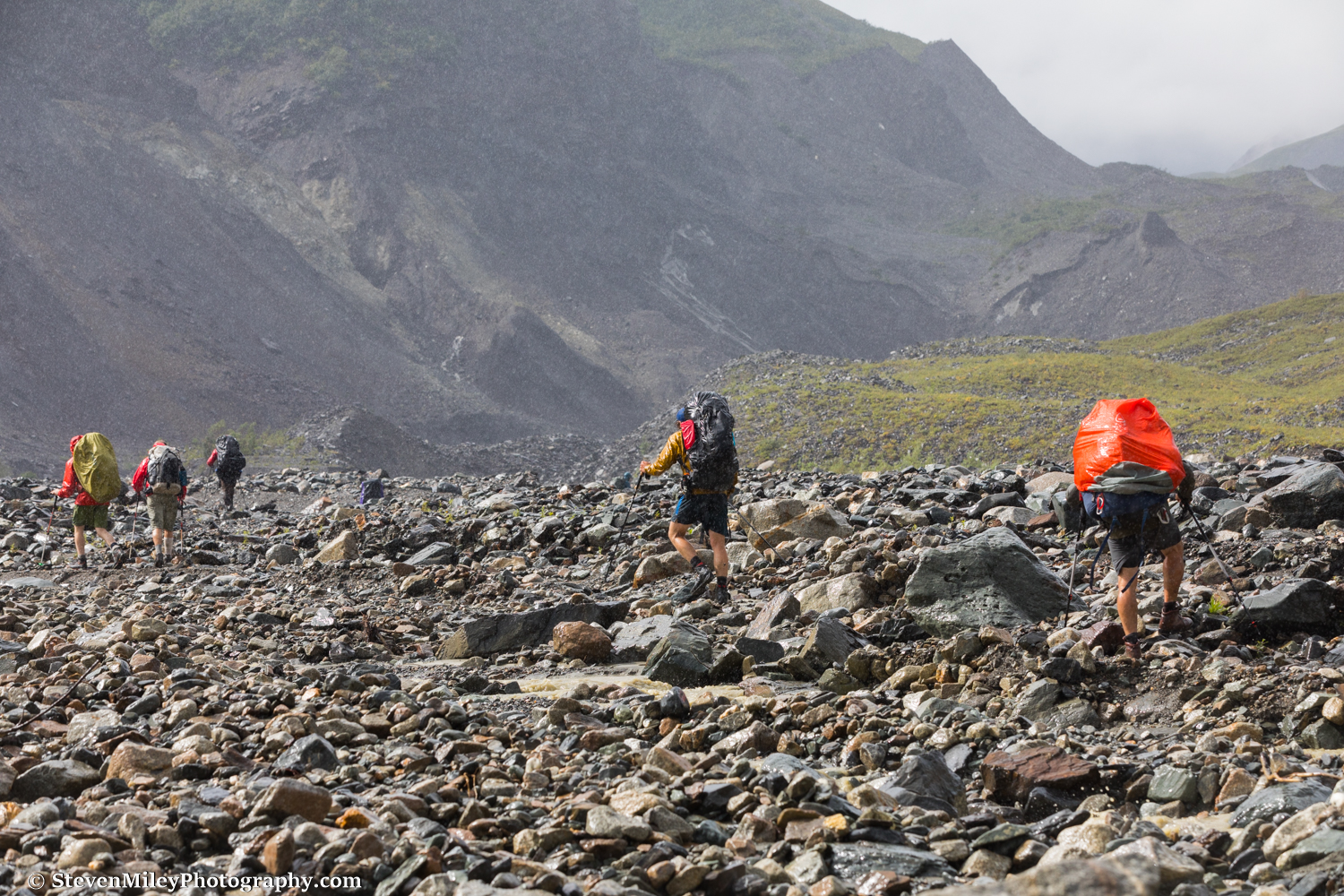
Crossing Hayes Glacier. The base of Mt. Hayes is at right.

Crossing Hayes Glacier. The base of Mt. Hayes is at right.

This is the second entry in a series covering my traverse from Black Rapids to Healy in early August 2018. Read Part I.

After three days of hiking we found ourselves about one day behind our estimated schedule for reaching our first food drop, which was waiting for us at an airstrip along the East Fork Little Delta River. We all had enough food to stretch an extra day but our pace was going to be slowed by another set of glacier crossings. Trident Glacier was the next obstacle in front of us, almost two miles wide with no clear path to the opposite side.

Day 4:

_L5A2962.jpg

Threatening clouds loomed in the distance as we scrambled onto Trident Glacier. Everyone was exhausted from the physical and mental stress of the previous day, and starting the morning off with a rugged glacier crossing didn’t aid in our recovery. But when we passed a captivating bulge of rock-free ice everyone stopped to marvel and take pictures, briefly forgetting the continuous need to cover ground. These were the sights we came for, and we were going to enjoy them no matter how tired we were.

_L5A2989.jpg

Steep, winding ice slopes and meltwater canyons forced us to take a circuitous path across the moraine of Trident Glacier. Climbing over hill after hill on a glacier like this is always slow-going and frustrating, especially with a heavy pack.
_L5A3004.jpg

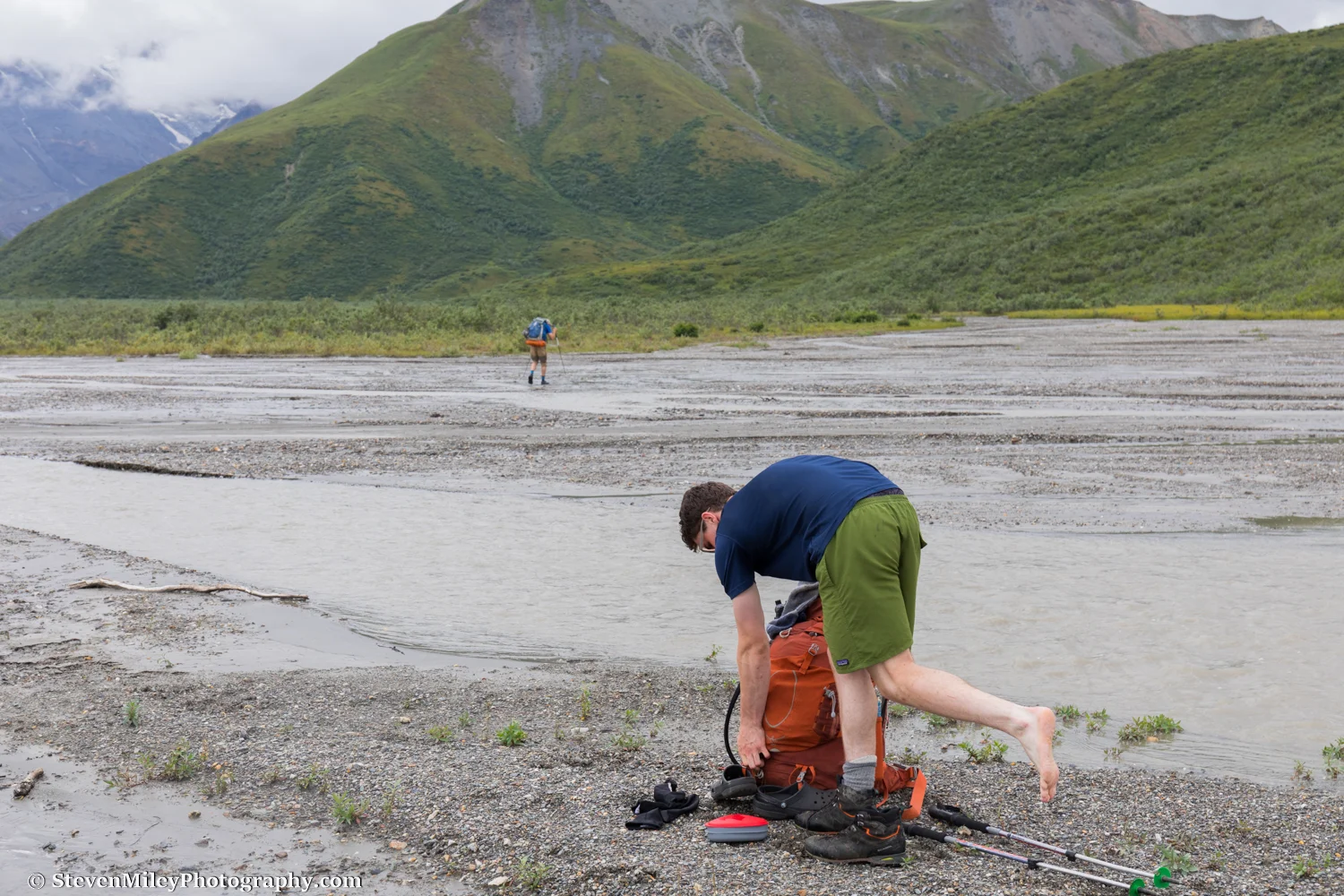
After crossing the Trident we reached a wide creek bed. The clouds were quickly lowering and we knew we were going to lose visibility again soon. We crossed a small braided stream and waded through marshy grass, which took some time because most of the team changed footwear to keep their hiking shoes dry. As we continued up the creek bed we spotted a caribou and two—people? They were presumably hunters dropped off by a bush plane, and they must have been surprised to see us pass by. We then climbed up a short, steep ridge following a game trail which led us onto a tundra plain full of squishy tussocks…and back into the fog. We navigated for another few miles without being able to see much, and we ultimately camped beside a small puddle that provided water for cooking. Several caribou passed our camp that night and the next morning.

Day 5:

_L5A3032.jpg

In the morning we could see the bottom half of Mt. Hayes but the summit remained obscured. We hiked across tundra to the eastern branch of Hayes Glacier, then opted to walk along the vegetation-covered moraine of the glacier for a short distance until we were in position to cross to the foot of Mount Hayes on the opposite side.

_L5A3082.jpg

Everyone’s mood lifted as we began crossing Hayes Glacier and the scale of the mountains unfolded before us, overcast skies notwithstanding. I could get lost for weeks in a spot like this. From here you could easily walk right up to the base of the unnamed 10,000+ foot peak in this shot, or to the bottom of the 8,000-foot northeast face of Mount Hayes.

_L5A3107.jpg

Finding water on a glacier in the summer is never a challenge. After taking a break here to fill up on water and eat lunch, we finished crossing the eastern branch of Hayes Glacier and stopped by two decaying cabins next to the foot of Mount Hayes. Ground squirrels had taken over the cabins (wood floors in the Alaska Range are asking for trouble) and a grizzly bear had left its mark in one of them. We actually bumped into the owner of the cabins a day later, who said he hadn’t been there in years. What a waste…

_L5A3147.jpg

It’s odd how glaciers are all so unique, even two as close together as the east and west branches of Hayes Glacier, which originate from opposite sides of Mount Hayes and eventually intersect. On the western branch there are several giant boulders propped up on pedestals of ice which have been insulated from the sun, probably more than I’ve seen on any other glacier I’ve hiked on. There are also moulons everywhere on this branch, ranging from rabbit hole-sized to subway tunnel-sized. For some reason, the bare ice on the western branch of Hayes Glacier is also more slippery than every other glacier I’ve hiked on—so slippery I would have preferred using a pair of Microspikes for traction, which I normally don’t need. It was a little too slippery for my companions, so we hugged the rocks as much as we could until we hopped off the glacier onto the adjacent hillside, which was annoyingly brushy considering we were still over 4000 feet elevation. We set up camp just before rain started falling again.

Day 6:

_L5A3175.jpg

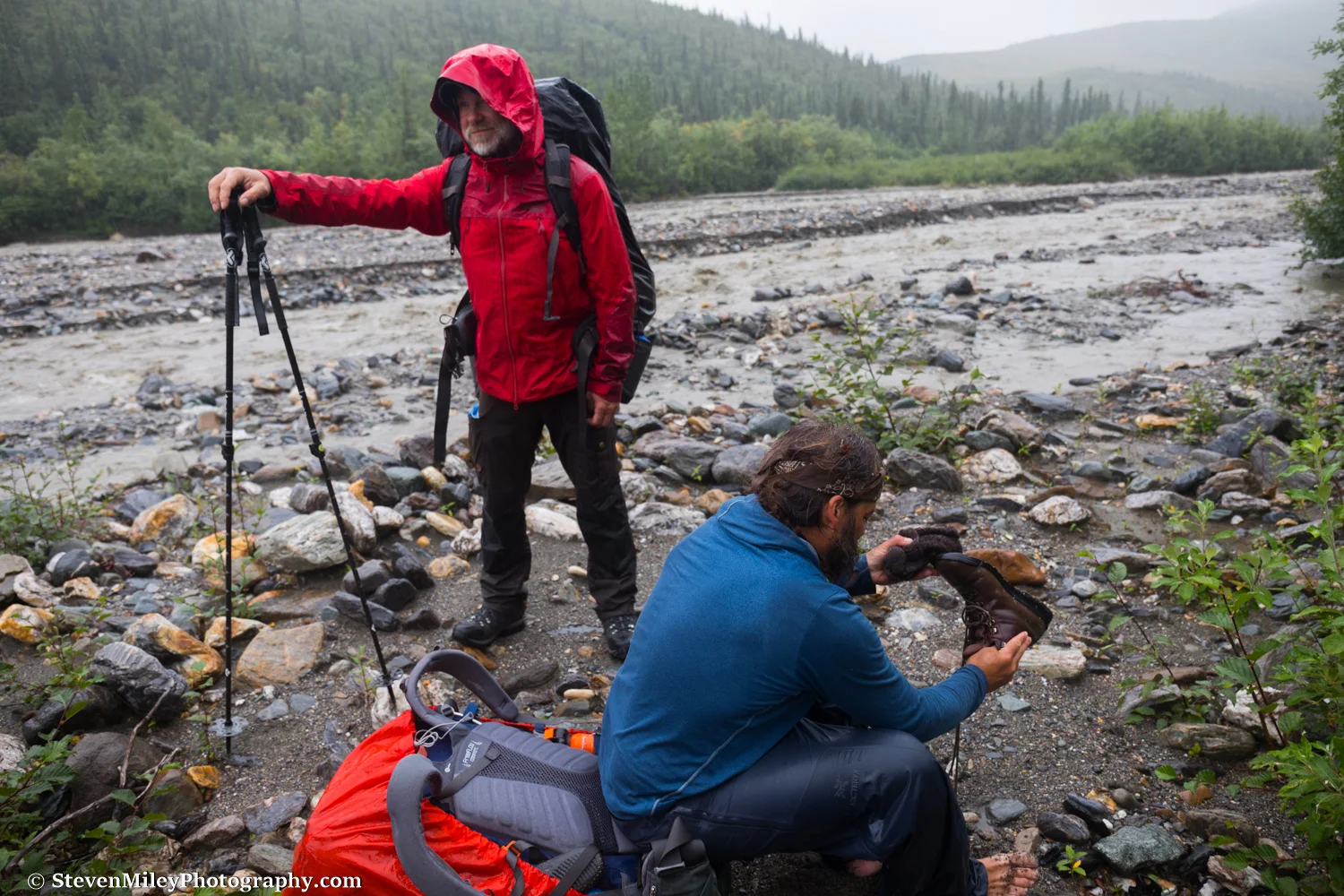
Route finding from Whistler Creek (seen here flowing into the East Fork Little Delta River) to our first food drop was difficult. The brush was dense in between, and it was unclear if following gravel bars would be easier due to the high water conditions. Rain began falling as we reached Whistler Creek, which was swollen from the previous days’ rain and breaching its bank in places. The water didn’t appear that deep but it was flowing incredibly swiftly and was unquestionably dangerous. The creek was not very braided where we intersected it, so we hiked upstream to find a better crossing, though nothing looked very safe. The two guys in our group with the most Alaska backcountry experience crossed first and successfully reached the far side, but two others in our group lost their footing as they crossed together and were swept a short distance downstream. They were lucky they weren’t injured, although one lost his hiking poles.
_L5A3189.jpg

At first I tried to cross solo but I quickly realized the water was eating away the gravel under my feet, making it difficult to resist the force of the water. I was still holding my boots in my hands and decided I should put them away to be safe, so I stepped back onto the gravel bar before I became committed to crossing. One of the two other guys still waiting to cross was very apprehensive after watching the two others fall into the creek, so the three of us decided to cross together in a line facing upstream, one behind the other. I was in back, and as we crossed I could feel the weight of the two men in front of me being pushed back by the creek. I found a boulder with my right foot and braced myself against it, propping them up so they could move laterally without being forced downstream. We successfully made it to the other side, where some of us changed footwear and put on dry clothes. If I were to do this again, I would take the long way and bushwhack downstream until I found a more braided spot to cross. It’s just not worth the risk.

_L5A3185.jpg

The water in the creek was so powerful it was sending big rocks hurtling downstream. A couple of guys received some nasty cuts and bruises on their shins. Thankfully, I had people in front of me to block any rocks coming at me. The rest of the way to the airstrip was a complete slog in the rain through flooded forest and soggy tundra. The blueberries were great, though.

_L5A3199.jpg

From left to right: me, Peter, Mike, John, Tim, Decker, Phillip, and Grant. John (in red) had a family emergency and had to depart when we finally reached the airstrip. The sun shined briefly as we took this group shot before he flew away, then it promptly disappeared for another three days. Tim and Decker had only planned to hike part of the way and both were set to fly out the next day. The next morning while everyone was still in their tents, Mike, who had been struggling to keep up at the end of each day, began a speech informing us his body just couldn’t handle the strain and he was calling it quits. He expressed concern about us continuing with the water levels so high, especially crossing the West Fork Little Delta River, and he listed cabin locations where we could find shelter if necessary. When he finished, Peter said he came to traverse the eastern Alaska Range and was prepared to continue by himself if need be, and I expressed my desire to complete the traverse as well. The brothers Phillip and Grant chimed in and said they were ready to keep going, too.

Just like that, we were down to four people with about 80 miles left to go. Read Part III & Part IV.

 

Black Rapids To Healy Traverse, Part I: Delta River to Trident Glacier

 
_L5A2444.jpg

In early August 2018 I traversed the eastern Alaska Range from Black Rapids to Healy. My companions and I used rafts for the initial Delta River crossing but we relied on our feet to carry us the remaining 120+ miles. We started with eight people, planned to finish with six, but ultimately finished with only four. Miserable weather plagued most of our trek as we crossed rugged glaciers, steep mountain passes, countless icy streams and rivers, thick brush, soggy tundra, and long valleys. I meticulously planned landscape shots of the big mountains of the Hayes Range before the trip, but not a single one came to fruition as the summits remained hidden in dreary overcast skies. At least I had the opportunity to take plenty of adventure shots. 

The goal of the traverse was to scout a route for a potential trail that experienced backpackers could complete without pack rafts. Pack rafts are great, but they're expensive and not widely available, and floating on Alaska's swift glacial rivers can be scary if you don't have any experience. With this in mind, we started our traverse by following the first major unnamed drainage south of McGinnis Creek because it would be a good place to build a bridge across the Delta River and the creek quickly leads to epic views, and we finished by following Healy Creek into the town of Healy which made the route naturally reversible and very scenic from start to finish.     

I certainly didn't take pictures of everything, including some rather amazing moments like a golden eagle flying right by my head, or the dozen caribou that ran past our camp in the fog while I was filtering water, or my companions and I crossing a stream containing cabin-sized chunks of ice collapsed off the side of Gillam Glacier. The captioned images included in this and upcoming posts will just have to suffice.  

Day 1:

_L5A2337.jpg

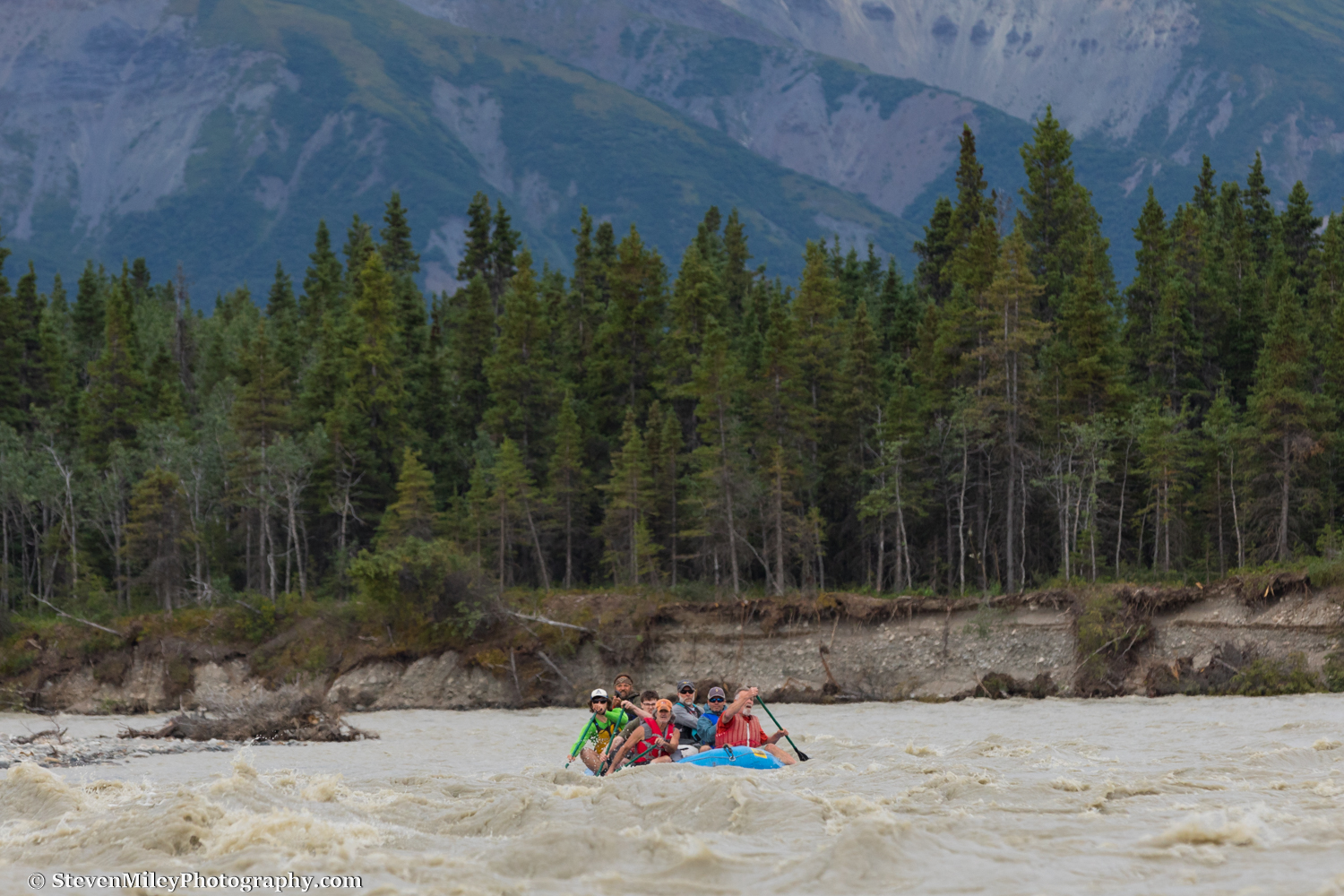
The adventure started from the very beginning. We didn't have enough pack rafts to cross the Delta River so the team rented a large raft which could ferry everybody and their gear across. I opted to cross the river in my pack raft because I didn't want to risk losing my camera gear and this way I could help rein in the big raft. We scouted the river very carefully before putting in and I followed the planned route easily, crossing to the far side of the river early on and taking out at the first available eddy. The others came around the bend in the river as I awaited with my camera, but as they grew closer I realized they were still in the middle of the river and going to sail past where I had landed. If you look at this image you can see the far edge of the river is mostly calm while the raft is heading for some rough waves which we intended to avoid. I watched my friends catch a couple of big splashes and narrowly avoid a big tree in the river as I raced along the edge to help them when they finally reached the shore. So many people (adventurers and hunters alike) have run into serious problems or have even been killed trying to cross the Delta River—don't understimate the danger. 


_L5A2490.jpg

After four or five miles of easy walking mixed with some moderate bushwhacking, intense rain began falling as we neared an unnamed glacier covered under rock debris and vegetation at the headwaters of the unnamed drainage across the Delta River. We nicknamed the drainage "Pillsbury Creek" and the glacier "Pillsbury Glacier" because they lie adjacent to Mount Pillsbury. The sun shined briefly before the rain stopped, then dense fog quickly rolled up the creek and swallowed the landscape. 


_L5A2511.jpg

After the fog set in we had to route find across "Pillsbury Glacier" with almost zero visibility, which was rather tough to do because we couldn't see the ice cliffs and other obstacles we had to circumvent until we stumbled onto them. If the conditions had been better I would have poked my head inside the big ice cave at the terminus. 


_L5A2589.jpg

After ascending a steep slope of loose rock on the far side of "Pillsbury Glacier" we began following a game trail up to a pass leading to McGinnis Glacier. As the terrain flattened out near the pass and the game trail faded out we had to consult our GPS reading several times to stay on the right course. We eventually found a small lake near the pass and set up our first camp, unable to see any of the scenery around us. The first day was a wake-up call to a few team members that the hike would be tougher than they thought.  


Day 2:

_L5A2673.jpg

The fog eventually lifted the next morning and we descended from the pass to McGinnis Glacier below. Crossing all the streams emptying from the glacier didn't appear practical so we opted to cross the rocky moraine.


_L5A2732.jpg

There was one rowdy stream flowing between the two branches of McGinnis Glacier we had to cross. We found a spot where it leveled out where the crossing wasn't that bad. If we had crossed the glacier moraine starting higher up we could have avoided some dead-end ice cliffs and we might have been able to avoid this stream crossing altogether. 


_L5A2745.jpg

After the stream crossing we took a less-than-optimal route over the second branch of McGinnis Glacier. Some members of the group didn't have much experience hiking over glacier moraines so they felt uncomfortable picking their way through the rubble. After making slow progress we decided to climb off the moraine and bushwhack along the edge where everyone would feel safe, but the last bit of hiking on the glacier turned out to be the most difficult and dangerous. It turned out there was a nice game trail on the edge of the glacier and the terrain quickly changed to open tundra after we gained a little elevation. We could have also cut directly to a prominent hump in the moraine leading to the far side.


_L5A2800.jpg

The light wasn't great but we at least got to see McGinnis Peak (center) from bottom to top later in the day. The cool thing about our chosen route was how close it brought us to some of the big mountains of the Hayes Range and how quickly we made it there. We also caught a couple short glimpses of Mt. Moffit through the clouds to the right of the 10,000+ foot peak on the right. I’ve visited this area once before and it’s an amazing place to catch a sunrise.


Day 3:

_L5A2816.jpg

Packing up in the mornings was a slow process with a big group. In this shot we are about to leave our camp near McGinnis Peak and circle around to Trident Glacier. The cloud ceiling was already lowering and soon we were enveloped in fog again as we climbed above 6000 feet elevation. We relied on GPS to help navigate until we dropped below the cloud ceiling again as we followed a drainage down to the glacier. In the fog we stumbled on a piece of unexploded ordnance inexplicably lying some 30 miles from the military's impact area to the north; what a shame that with all the possible ways I could die in the wilderness I have to add being blown up to the list. 


_L5A2833.jpg

When we reached Trident Glacier steady rain was falling and we could only see the bottom half (or maybe third) of 13,000+ foot Mt. Moffit, though we stood less than a mile from its base. Dall sheep were mulling around its lower flanks. An eye-catching icefall separated the heavily glaciated backside of McGinnis Peak from Mt. Moffit. Even with the mountains mostly hidden everyone still felt awed by the scale of the rock and ice visible to us. 


_L5A2857.jpg

Another shot of the northwestern flank of McGinnis Peak and the dramatic icefall at its base. We could have saved some mileage by cutting north and bypassing this area but the closeup views were worth it. I can only imagine how awesome it would be to see the entirety of Mt. Moffit looming overhead from this spot; it would be an iconic view that would attract people from all over the world if there were a trail leading to it. We paralleled the glacier for several miles following game trails as best we could until we found a good crossing point where we set up camp. 

_L5A2920.jpg

Tired, wet, cold, hungry. We encountered no water sources as we hiked beside Trident Glacier so we resorted to filtering water from puddles on the tops of boulders and gathering silty water from the glacier below.

Read Part II, Part III & Part IV.