Onemile Creek Frozen Waterfall

 
Looking up from an opening behind a frozen waterfall along Onemile Creek in the Alaska Range, near Black Rapids.

Looking up from an opening behind a frozen waterfall along Onemile Creek in the Alaska Range, near Black Rapids.

I've stumbled across several waterfalls in the backcountry of the Alaska Range, but I usually only spy them from a distance because they are either too far out of my way to visit or else located in inaccessible cliffs. Last winter, I found a couple photogenic frozen waterfalls while skiing up an unnamed creek just north of Black Rapids along the Richardson Highway. That creek is actually mislabeled "One Mile Creek" by a highway sign, while the real Onemile Creek lies to the south, flowing down through a narrow cut in the mountains. I spotted a large waterfall glinting in the afternoon sun along Onemile Creek from the highway a few years ago but it wasn't until I found the waterfalls along the faux "One Mile Creek" that I finally decided to pay the real Onemile Creek a visit.    

Frozen waterfall along the "faux" One Mile Creek.

Frozen waterfall along the "faux" One Mile Creek.

The blue ice behind the Onemile Creek waterfall. Bring a wide angle, squat down and look up!

The blue ice behind the Onemile Creek waterfall. Bring a wide angle, squat down and look up!

While "One Mile Creek" featured a few steep pitches and some other hazards that would make it an inappropriate adventure for the inexperienced, the route to the base of the Onemile Creek waterfall makes for a rugged but relatively easy snowshoe. That being said, if you aren't planning on ice climbing, you will have to do some steep scrambling to get over the lower two falls to reach the more impressive upper fall.

I made an initial scouting trip to the waterfall with a friend on a mostly cloudy afternoon in late March. We slogged through deep snow up the hillside above the waterfall where we had a great view overlooking the Delta River valley. When we descended to the base of the upper fall, there appeared to be an opening behind the ice on either side about halfway up. The opening on the left was guarded by rocky cliffs, and while it looked possible to scramble up the cliffs without a rope, I decided it would be too risky with the loose snow covering the rock. I walked up the steep snow slope to the opening on the right and was pleased to find a tall curtain of translucent blue ice when I stuck my head inside. There wasn't much space to maneuver, but there were still plenty of interesting angles to explore. Before leaving, I noted the time and the position of the sun in the sky and estimated that I could catch the sun fully illuminating the waterfall if I returned on a clear day around 6-7 p.m. 

I returned to the waterfall a couple weeks later on a beautiful spring day with another group of friends. We could see the ice of the waterfall gleaming in the late afternoon sun when we parked along the highway, and we passed several moose on the way to it. The snow on the cliffs to the left of the upper fall had melted away, so I psyched myself up for a dangerous scramble and made like a Dall sheep up the cliffs to the opening I had yet to explore. Once inside, I found it was a little deeper than the other opening but not as tall. The shapes in the ice itself were not quite as striking, but the glow was still captivating and the view peering out from the opening was more interesting.

Late afternoon/early evening sun shining on the OnemIle Creek waterfall. There are small openings behind the waterfall on either side.

Late afternoon/early evening sun shining on the OnemIle Creek waterfall. There are small openings behind the waterfall on either side.

Closeup of a plant clinging to the cliffs behind the ice of the Onemile Creek waterfall.

Closeup of a plant clinging to the cliffs behind the ice of the Onemile Creek waterfall.

The "floor" inside the opening consisted of thin, murky ice with water underneath. The ice wasn't going to hold my weight so I did my best to position my tripod on it and compose my shots while crouched on the adjacent rocks. After shooting the blue ice for a while, I turned around and realized the sun was shining directly inside the opening. The view was rather unique and I knew it wouldn't last very long, so I attempted to capture it by pointing the camera in my direction and ducking while the camera took the picture. It took several tries to get the focus and composition right, but I didn't realize until later that my backpack was silhouetted at the bottom of the frame in all the shots. Luckily, I was able to save one or two images by cropping a little tighter than I normally prefer. 

The early evening sun shines behind the frozen Onemile Creek waterfall.

The early evening sun shines behind the frozen Onemile Creek waterfall.

In May I might try to catch this waterfall as it "opens up". There's certainly plenty of water flowing beneath the surface of the waterfall already, but in a matter of weeks that water should be flowing over the top while the ice to the sides continues to slowly melt. Looking forward to a summer stroll to the waterfall as well! (Update: I did see water flowing over the ice in May as I passed by on the highway, but when I returned a couple days later with my camera the water had disappeared under the ice. Maybe next year...)  

Want to see this waterfall? Check out my Black Rapids Tours winter offerings.


Canwell Glacier Ice Tunnel

 
Details and reflections in the wall of the Canwell Glacier ice tunnel.

Details and reflections in the wall of the Canwell Glacier ice tunnel.

A large meltwater canyon twists down the rugged moraine of Canwell Glacier and the frigid stream that rushes through it in the summer has carved an impressive tunnel beneath the surface of the glacier. I found the tunnel by chance four years ago and have visited it every winter since. The entrance has morphed considerably over time, but the interior is better insulated and has remained mostly recognizable from one winter to the next. 

On my first trip to the tunnel this winter I brought along my friends Forrest and Nigal. Orange and pink clouds were rolling over the mountains when we parked beside Miller Creek shortly after sunrise, and the cold breeze promised the approach would not be very enjoyable. My skis sank several inches into the fresh snow as I skinned up the creek while my companions sank about a foot in their snowshoes. After a couple miles of strenuous trail breaking the glacier came into view and the wind began blowing directly in our faces. The frost on my eyelashes felt like glue trying to hold my eyelids shut. 

After reaching the glacier we began climbing up and down over the hilly moraine until we stood looking at the tunnel entrance from above. It was guarded by steep walls of snow, so we were forced to circle around to it via a gentler slope. Forrest scrambled down into a new ice cave adjacent to the tunnel and took a look around, but Nigal and I were content to skip it. The three of us then shimmied up the final hill and gazed down at the aquamarine ice curving into darkness below.

Descending to the ice tunnel entrance in the moraine of Canwell Glacier.

Descending to the ice tunnel entrance in the moraine of Canwell Glacier.

I descended into the tunnel and dumped my skis next to a small hole in the rocky debris covering the tunnel floor. The hole led to a "secondary" tunnel which joined with the "primary" tunnel a short distance downstream. We walked down the primary tunnel to the "confluence", then switched on our headlamps and ducked along the dark secondary tunnel until our progress was stopped by a wall of ice glowing a dim translucent blue in front of us. We saw daylight shining through the hole where I left my skis, and I imagine that daylight will be replaced by a waterfall in the summer.

The Canwell Glacier ice tunnel entrance. The hole leading to the "secondary" tunnel is obvious at the bottom of the snow slope.

The Canwell Glacier ice tunnel entrance. The hole leading to the "secondary" tunnel is obvious at the bottom of the snow slope.

We waltzed along the ice floor back to the confluence where the tunnel opens into a ballroom-sized "cavern". A tiny bit of daylight reflects indirectly off the ice into the cavern, but it isn't enough to see without a headlamp. Even with a headlamp, though, walking on the uneven floor looking for the continuation of the tunnel is quite disorienting and conjures to mind every monster movie I've ever seen.  

In the "cavern" portion of the Canwell Glacier ice tunnel. The bluish light is daylight.

In the "cavern" portion of the Canwell Glacier ice tunnel. The bluish light is daylight.

We found the path ahead and continued following the tunnel as it curved back and forth into total darkness. The hiss of running water echoed downstream and it grew louder the farther we walked as though we were approaching a roaring waterfall. The source turned out to be a small stream escaping from under the ice floor and cascading over rocks, which we carefully hopped across to avoid getting our feet wet. The floor of the tunnel switched to rocks and we rounded one more curve before the ceiling lowered and we were reduced to walking "Gollum-style". The ceiling quickly lowered even further and we decided crawling over the rocks on the floor wasn't worth the effort to find out how much farther the tunnel extended.     

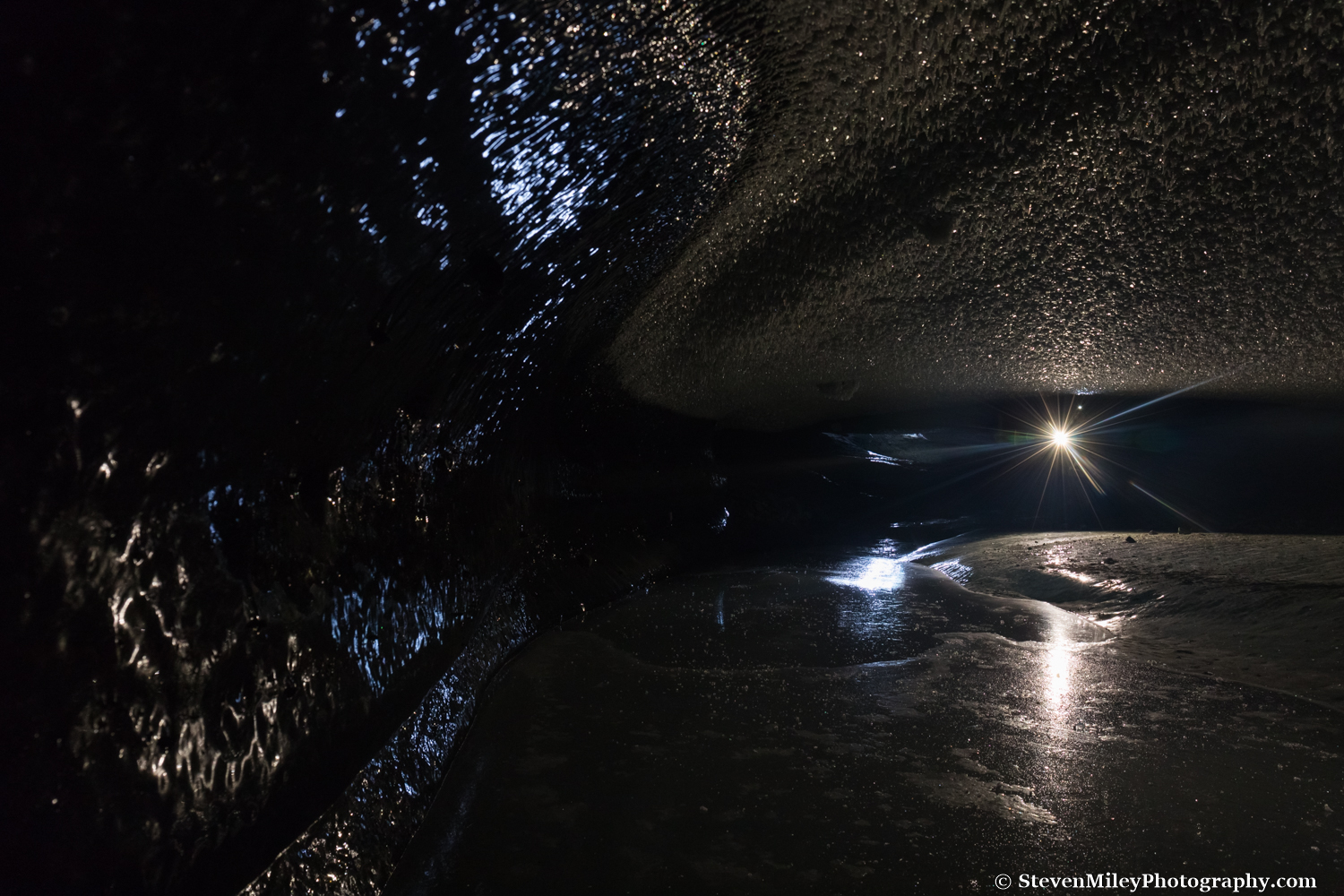
Near the end of the tunnel it felt quite warm, perhaps slightly above freezing. I photographed some of the interesting features using our headlamps for lighting but had to fight condensation on the lens. Perhaps the most interesting thing we found was a patch of icicles oriented horizontally on the floor, like frozen fingers reaching out of the ground at our feet. 

Strange icicle formations on the floor of the Canwell Glacier ice tunnel.

Strange icicle formations on the floor of the Canwell Glacier ice tunnel.

We paused in the cavern for lunch on the way back to the entrance. That is, I paused to take some pictures while my starving companions decided it was as good a place as any to eat. Forrest munched on Pringles, Nigal ate cold Spaghettios out of the can, and I ate a mostly frozen Snickers. Having adjusted to the darkness, my eyes recoiled in pain when I glanced at the bright daylight shining through the gaping tunnel entrance, like stepping out of a movie theater after catching a matinee. A couple hours had gone by and the day had warmed up, but it still felt cold in the shade near the front of the tunnel. My friends were a bit antsy to get moving but I probably spent another half-hour messing around with the camera before we left.  

Peering out the entrance of the Canwell Glacier ice tunnel.

Peering out the entrance of the Canwell Glacier ice tunnel.

On our return to the highway the wind had died down and the sun was shining. By the time we left the glacier moraine I had become uncomfortably warm, so I unzipped my jacket and took my gloves off. The trail we set earlier pointed directly toward towering Mt. Shand as we retraced it in the opposite direction, and our tired legs were thankful they didn't have to break trail again. With the mountains burning a hypnotizing orange and the shadows quickly overtaking Miller Creek, a cow moose crossed the creek about a hundred yards behind me and the snow reached the moose's chest as it struggled to reach the other side. We arrived at the highway before sunset without having seen a sign of another person all day. 

Nigal retraces the snowshoe track across a steep section of Canwell Glacier on the way back to the Richardson Highway.

Nigal retraces the snowshoe track across a steep section of Canwell Glacier on the way back to the Richardson Highway.

I've seen several other ice caves and tunnels come and go on Canwell Glacier, but I suspect this ice tunnel will continue to survive for a while longer. I'll be back next winter to find out.

For tips on photographing ice caves, read my post How to Photograph An Ice Cave.
Interested in visiting or photographing an ice cave? I offer guided winter tours. More information.