Black Rapids Glacier February 2018

 
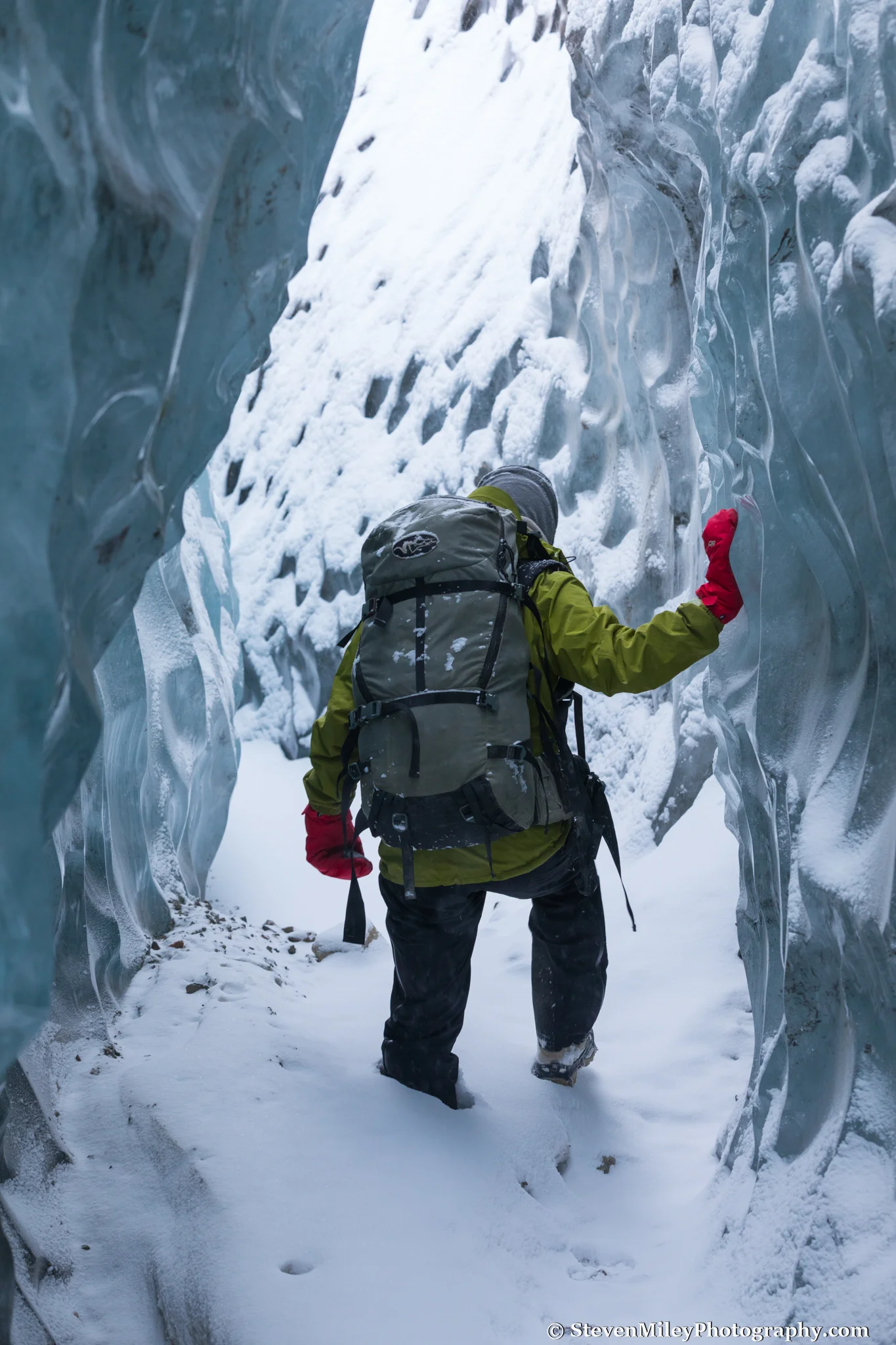
An ice tunnel in the moraine of Black Rapids Glacier.

An ice tunnel in the moraine of Black Rapids Glacier.

What a difference a month makes. I hiked to Black Rapids Glacier last weekend after visiting the glacier previously in January and the return of the sun made the hike infinitely more enjoyable and my photographs much livelier than last time. With a merry group of companions I crossed the Delta River early in the morning and started hiking along the glacier creek. We made good time walking on the ice with spikes on our shoes but after a couple miles continuous snow cover slowed our pace, except for my friend Tim who began gliding along on the skis he had carried on his back.
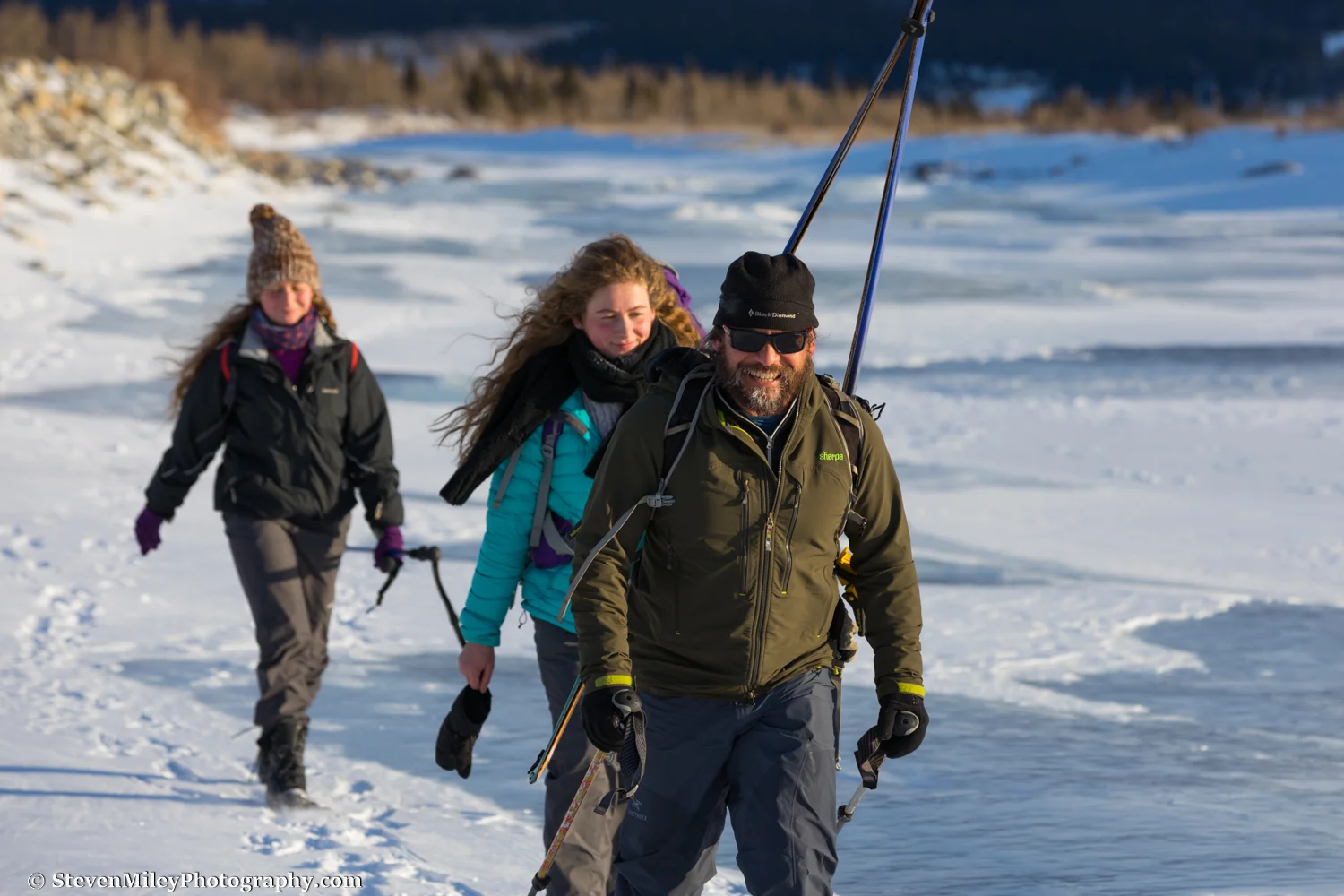
Asia, Gabriela, and Tim hiking along "Black Rapids River". I'm not sure how Tim got ice in his beard so quickly—I suspect he intentionally cultivated his look.

Asia, Gabriela, and Tim hiking along "Black Rapids River". I'm not sure how Tim got ice in his beard so quickly—I suspect he intentionally cultivated his look.

As we neared the terminal moraine we encountered open water, which we crossed via a questionable ice bridge. We could have walked the not-so-long way around but no one in the group thought that sounded like fun.

Crossing open water near Black Rapids Glacier.

Crossing open water near Black Rapids Glacier.

None of my friends had visited the glacier before so they were all incredibly awed when they reached the terminal moraine and got to see and feel the impressive blue ice. I knew they would be even more astounded the further they explored. Black Rapids Glacier is a seemingly endless supply of natural ice marvels and it's hard to believe when you're out there that a place so amazing and so easily reachable could feel so wild and untouched. 

Inspecting a crack in a giant wall of ice at the terminus of Black Rapids Glacier.

Inspecting a crack in a giant wall of ice at the terminus of Black Rapids Glacier.

A few barely-perceptible white dots on top of the mountain ridges above us seemed to appear and disappear occasionally: Dall sheep. We passed many animal tracks early in the hike, but once we reached the glacier moraine we only saw one lone set of wolverine tracks crossing the glacier valley.  

Wolverine tracks on Black Rapids Glacier.

Wolverine tracks on Black Rapids Glacier.

We paused for lunch atop an ice bulge next to a pointy ice formation that could have passed for an abstract outdoor sculpture. We had fallen into the shadow of the mountain ridge on the south side of the valley, but sunlight steadily crept closer to us along the glacier moraine while we ate. When we resumed hiking we were soon basking in the sun's warmth, a warmth that is sorely missed during the months of November, December, and January in Interior Alaska. I took my gloves off for awhile. 

Collapsing ice in the moraine of Black Rapids Glacier.

Collapsing ice in the moraine of Black Rapids Glacier.

I decided to lead the group past the ice cave I visited in January and look for new features farther up the moraine. We hadn't walked very far when I spotted a huge ice tunnel nearby. On either side of the tunnel entrance was a tall chasm in the ice, one leading left and one leading right. My companions disappeared in different directions while I broke out my tripod and started photographing.  

The entrance to the Black Rapids Glacier ice tunnel.

The entrance to the Black Rapids Glacier ice tunnel.

Barbara at the far end of the Black Rapids Glacier ice tunnel.

Barbara at the far end of the Black Rapids Glacier ice tunnel.

We eventually reunited outside the tunnel in the golden afternoon sun with our minds blown. I snapped a group portrait and we continued up the moraine until the sun began to disappear behind the mountains. There was plenty left to explore but we were running out of daylight and energy, so we turned around. As we prepared to go, we heard the SOS beacon beeping in Tim's bag. We had rendezvoused at the Lodge at Black Rapids before starting our hike and the owner had lent us the beacon in case of an emergency. Somehow, hours earlier, one of the beacon's preset messages was sent to the lodge reading, "We need help immediately. Pick us up at this spot." When we didn't respond to their follow-up responses the lodge staff organized a search party to look for us. We sent a message saying we were alright and the search party turned around about half-way to the glacier.

Heading back to the highway under fading daylight.

Heading back to the highway under fading daylight.

The stars were just starting to emerge when we reached the Delta River. We broke out our headlamps and crossed the ice, then powered up the final slope back to our vehicles. The lodge staff greeted us with dinner when we arrived and recounted their own adventure trying to "rescue" us. Too bad for them they didn't try to rescue us sooner or they could have seen some of these amazing sights!

The last bit of hiking before reaching the Richardson Highway.

The last bit of hiking before reaching the Richardson Highway.

For tips on photographing ice caves, read my post How to Photograph An Ice Cave.
Interested in visiting Black Rapids Glacier or seeing an ice cave? I offer guided winter tours. More information.


Black Rapids Glacier January 2018

 
The entrance to a spacious, crumbling ice cave in the moraine of Black Rapids Glacier.

The entrance to a spacious, crumbling ice cave in the moraine of Black Rapids Glacier.

Forrest just before he plunged his foot into slush.

Forrest just before he plunged his foot into slush.

I continued my tradition of hiking to Black Rapids Glacier in January last Saturday. My adventure buddy Forrest accompanied me and we arrived at the Delta River shortly before sunrise under cloudy skies and light snow. We crossed the river ice just upstream of an unfrozen section, then started hiking up the unnamed creek that flows from the glacier. Recent strong winds and warm weather had wiped out most of the snow along the creek so we were able to walk without skis or snowshoes on a thin layer of fresh snow, avoiding several areas where the surface ice had collapsed. With the temperature around 0 °F (-18 °C) and the breeze at our backs, the hike in was a lot more enjoyable than the worst case conditions we were expecting. About halfway to the glacier we stopped to attach Microspikes to our boots to keep from slipping and it was almost as easy as walking on solid ground after that. Blue ice eventually came into view, and we steered toward the rightmost side of the glacier moraine.   

We walked along a street-sized gap between giant blocks of glacier ice until we turned down a sidewalk-sized wedge in one of the blocks, post-holing through a rotten mixture of snow and debris. Forrest unwittingly stuck his boot in slush at one point, but luckily avoided getting any water inside. (Such mishaps always remind me of "To Build A Fire", but I don't think you'll ever catch me attempting something like this in -50 °F.) We climbed up a snow ramp at the end of the wedge and continued over the moraine into a large, flat depression—surely a frozen glacial lake. While crossing the middle of the lake we heard the ice creak beneath our feet, so we quickly hugged the perimeter to avoid taking an unexpected dip. After marveling at the details in the glacier ice encircling the lake, we climbed over the rim on the far side and worked our way back to the creek, continuing farther upstream beside the moraine. We passed a few ice formations that looked vaguely familiar from last winter and plenty of new ones.

After a short time, we hopped back onto the moraine and followed a sizable meltwater channel into a spacious ice cave. The cave wasn't very deep, but it was tall and featured a lot of crumbling ice. As soon as the sun starts shining on the cave in February and melting the ice again, the large rocks looming precariously above the entrance will become quite dangerous as they start sliding off. Even without the ice melting, one side of the cave interior looked rather unstable and dangerous, but we were content to hang out on the other side for a bit while we ate lunch and sheltered from the breeze.   

Crossing the frozen glacial lake.

Crossing the frozen glacial lake.

The interior of the ice cave. In the melting season, water presumably runs around the pieces of collapsed ice and into the gap under the ice in the back of the cave.

The interior of the ice cave. In the melting season, water presumably runs around the pieces of collapsed ice and into the gap under the ice in the back of the cave.

Due to January's short daylight hours, we began our return after exiting the cave. The clouds began thinning and the snow stopped falling, and the surrounding mountains that had been cloaked all day soon emerged, including Mt. Silvertip across the Delta River. We walked with our masks and goggles covering our faces, but the cold breeze still managed to bite my face from time to time. With less than a mile to go we came across a fresh set of wolf tracks, which paralleled our old tracks for a lengthy distance until they disappeared into the brush beside the creek. The river finally came into sight and we crossed it just after sunset. I felt comfortably warm most of the day, but I was happy to turn on the seat warmer and pull off my frozen face mask after we started driving back to Delta Junction.

I will explore Black Rapids Glacier again later in February when I have more daylight and (hopefully) warmer weather. The glacier really is a photographer's playground and it isn't that hard to reach, so I'm lucky few other people venture out there. 

For tips on photographing ice caves, read my post How to Photograph An Ice Cave.
Interested in visiting Black Rapids Glacier or seeing an ice cave? I offer guided winter tours. More information.