Peters Glacier

 
Denali looms over Peters Glacier (coming out of the valley at right) and the Muddy River. An avalanche is visible near the center of Denali's Wickersham Wall.

Denali looms over Peters Glacier (coming out of the valley at right) and the Muddy River. An avalanche is visible near the center of Denali's Wickersham Wall.

Denali from Wonder Lake looks big, but it still looks far awaystatic and bit hazy. Yet, except for a few backpackers who follow the well-documented route to McGonagall Pass every summer and the occasional park ranger or old-school mountain climber, virtually no one tries to get closer to the mountain on foot than Wonder Lake. One of my goals this summer was to hike close enough to Denali to feel truly humbled by its size and create unique images of the mountain from close range. I looked at the map and found a simple route leading from Wonder Lake to Peters Glacier, which winds around the base of Denali's Wickersham Wall and Pioneer Ridge. The route would be easier than hiking to McGonagall Pass and would also bring me closer to Denali's North Peak, with better views of the mountain along the way. I found extremely little information and few photos of this area of Denali National Park on the web, which made it that much more intriguing.

With only a couple weeks left until the end of bus service in Denali National Park, I set out for Peters Glacier with a less-than-optimal weather forecast, but perhaps the best I might get until next summer. I picked up my backcountry permit at the Backcountry Information Center and caught the last camper bus into the park. The fall colors were in full swing and I had to resist the urge to hang out the window with my camera as the bus wound around the dizzying cliffs near Polychrome Pass. At the end of my six-hour ride, the bus driver dropped me off at the McKinley Bar Trail and handed me a few snacks as a gesture of good luck. ("You won't find any social trails out there," he told me.) The sun had already set and I hiked down the trail under twilight to the McKinley River, where I staked my tent down on the gravel bar using rocks and went to sleep.

Camping on the McKinley River Bar

Camping on the McKinley River Bar

The next morning I awoke to low-lying clouds blanketing the river and blocking the Alaska Range from view. I packed up my gear, then crossed several shallow braids of the river on foot until I came to a braid that was deep enough to float. I inflated my pack raft, tied my backpack to it, then pushed off into the water, unsure of what surprises the river might provide but confident they wouldn't be problematic. After a few minutes I passed a caribou skull lying upside down on the gravel bar with antlers still attached, which I optimistically viewed as a good omen. After a mile or so, I saw a man hiking upstream on the south side of the river. I paddled to shore to greet him and make sure he was alright. His wife was waiting at camp while he scouted the river for a spot to cross back over to the Bar Trail. The couple had originally intended to hike to McGonagall Pass, but that backcountry unit was full when they arrived at the park so they had attempted to hike to Peters Glacier in the neighboring unit instead. They ran out of time, but for a couple from San Francisco on their first trip to Alaska I was rather impressed by how far they made it. They were the last people I would see until I returned to the McKinley Bar Trail three days later.   

Preparing to pack raft the McKinley River from the McKinley Bar Trail to the Muddy River.

Preparing to pack raft the McKinley River from the McKinley Bar Trail to the Muddy River.

After a few miles the gravel bar narrowed considerably and it became easier to avoid getting stuck in shallow braids. I paddled around a few potentially dangerous boulders and trees in the water as the river carried me swiftly downstream, but the hazards were minimal. I reached the confluence with Clearwater Creek and for several hundred feet the crystal clear water from the creek flowed parallel to the silty water of the McKinley River without mingling; I could see the river bottom on my left, but couldn't see an inch below the surface on my right. I arrived at the confluence with the Muddy River a short time later and dragged my raft ashore. At that moment light drizzle began falling and I decided to take shelter under my raft in the trees nearby while I waited for the rain to pass. The rain intensified and it became clear it wasn't going to stop anytime soon. With temperatures falling close to freezing at night, I didn't want to risk hiking in the rain all day and becoming soaked—bad memories of my recent Katmai trip were still fresh in my mind. Instead, I set up my tent underneath my raft and spent the rest of the day and most of the night wondering if the rain would ever stop. 

The sun was shining on the McKinley River when I stepped outside my tent the next morning. Clouds were still blocking my view of the Alaska Range but they seemed to be dissipating quickly. I walked around the gravel bar looking at wolf, moose, and caribou tracks as I warmed up in the sunshine. Soon, an impressive snow-covered mountain emerged in the distance: it was Mt. Foraker, Denali's "little" buddy to the west. Minutes later, Denali's North Peak emerged above the clouds, towering impossibly high in the sky and completely dwarfing the 17,400-foot Foraker. 

Denali sporting fresh snow on a brisk fall morning, viewed from my campsite at the confluence of the Muddy River and McKinley River.

Denali sporting fresh snow on a brisk fall morning, viewed from my campsite at the confluence of the Muddy River and McKinley River.

I was behind my planned schedule due to the rain, but I could see fresh snow at low elevation in the distance and I knew there would probably be too much snow on Peters Glacier for me to hike all the way to the Wickersham Wall as I had hoped, anyway. After drying out my camping gear in the sun, I stowed my raft and started hiking up the Muddy River. I stuck to the east side of the gravel bar except where the river forced me into the brush, which I found surprisingly easy to walk through unlike the horrid bushwhacking that I usually find along the edges of most creeks and rivers in Alaska.   

With Peters Glacier in sight and sunset approaching, a bull moose suddenly appeared on the opposite side of the river. Two females emerged from the brush and joined him, and they cautiously observed me for some time even though I backed up considerably. The light wasn't perfect but I snapped as many shots of the moose with Denali towering in the background as I could until they finally crossed the river and disappeared into the brush.  
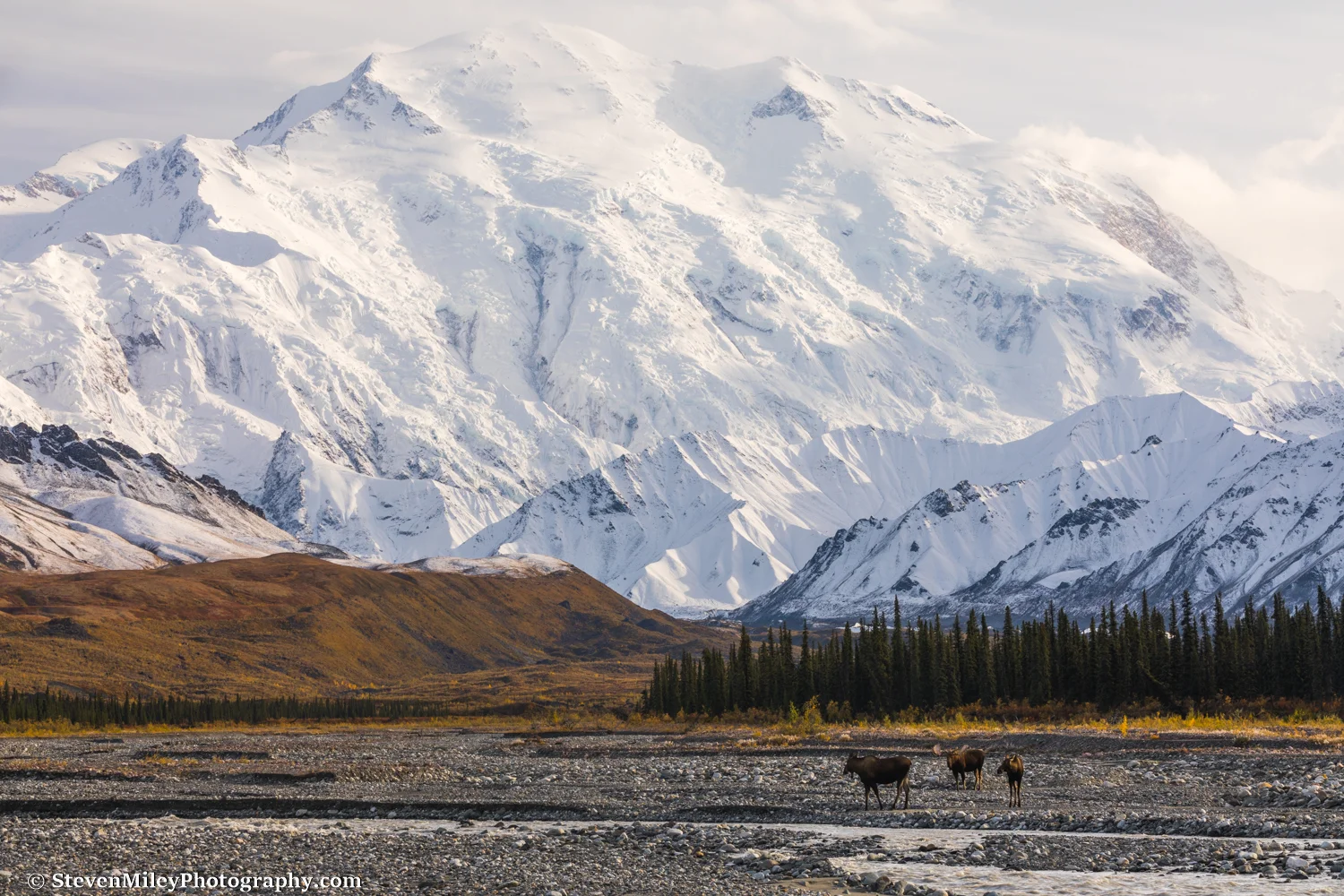
A bull moose and two cows on the gravel bar of the Muddy River with Denali in the background.

A bull moose and two cows on the gravel bar of the Muddy River with Denali in the background.

As soon as the warm color of sunset began to drape the mountain, I stopped worrying about covering distance and focused on taking photographs since I knew this might be the only decent sunset or sunrise I might see during my entire trip. (And it was.) I was so close to the mountain I saw an avalanche tumble down the Wickersham Wall, and several seconds later I heard the rumble. Unfortunately, distant clouds on the horizon blocked the best of the evening alpenglow. I set up camp in the brush hoping to catch the alpenglow at sunrise.

Denali's Pioneer Ridge and North Peak are lit up at sunset.

Denali's Pioneer Ridge and North Peak are lit up at sunset.

The next day dawned overcast, though the mountain was still completely visible. I entertained no expectations of capturing any stunning mountain images that day, but I was intent on gaining a clear line of sight to the base of Denali before turning back. I followed the Muddy River as it narrowed into a single channel and curved to the west, then hopped onto the moraine of Peters Glacier, which is covered in debris and vegetation near the terminus. I worked my way across the moraine to the tundra bordering the east edge of the glacier and climbed up the hillside, passing tons of berries and signs of bear.

Hiking among the rocks and boulders on the moraine of Peters Glacier. 

Hiking among the rocks and boulders on the moraine of Peters Glacier. 

As I gained elevation, I encountered thin patches of snow that hadn't melted since the storm a couple days prior. When I reached a high point on the hillside, I could finally see the bend in Peters Glacier where it curved around the base of Pioneer Ridge. Denali was so close I felt like I could reach out and touch it. A few more miles of easy hiking and I could have done so.

The base of Denali meets Peters Glacier.  

The base of Denali meets Peters Glacier.  

In the other direction, I saw the 20+ miles I would need to hike by 4 p.m. the next day to catch the last bus back to the park entrance. As much as I wanted to overstay my permit, I knew I could easily come back next year in better weather and spend more time exploring. I started my trek back to my campsite, pausing occasionally to gulp down a handful of blueberries. 

Possible ice cave formation in the moraine of Peters Glacier.

Possible ice cave formation in the moraine of Peters Glacier.

When I reached camp, I ate the last of my Colby Jack cheese, packed up my gear, then started hauling my heavy pack down the Muddy River until it was too dark to hike any further. I set up camp on the gravel bar with the McKinley River in sight about three miles away. Clouds hovering over the peaks of the Alaska Range ruined another sunrise the next morning, but the rest of the sky was clear and the day had warmed up quite nicely by the time I reached the McKinley River. I retrieved my pack raft, which noticeably slowed my pace and weighed on my tired legs and shoulders.

Hiking along the McKinley River was just as nice as the Muddy River until I reached Clearwater Creek. The creek was swift and deep, but I didn't want to waste time inflating and deflating the pack raft so I waded through the thigh-deep icy water. At the deepest point, I started thinking perhaps I shouldn't be filming with my expensive, non-waterproof DSLR, but I could see clear to the bottom and knew the current wasn't going to get any worse. The sun was shining brightly and I dried out quickly after crossing. I crossed and re-crossed one problematic braid of the McKinley River a few miles later, but that water only came up to my knee.

Immediately downstream of the confluence of Clearwater Creek and the McKinley RIver. The water is very swift and deeper than it looks in this image.

Immediately downstream of the confluence of Clearwater Creek and the McKinley RIver. The water is very swift and deeper than it looks in this image.

I spotted a bright, stationary yellow object across the McKinley River near the Bar Trail and surmised it must be a tent. As I crossed the numerous braids of the McKinley River, the deepest of which reached the top of my thigh (though it seemingly wasn't as powerful as Clearwater Creek), I realized the object was actually a jacket worn by a person relaxing in a chair on the other side of the river. In fact, there were several people mulling around on the safe side of the river enjoying the nice weather and mountain views. I couldn't help but think Denali looked a bit small and hazy when I turned around to view it one last time before hiking up the Bar Trail back to the park road. 


Katmai National Park August 2017

 
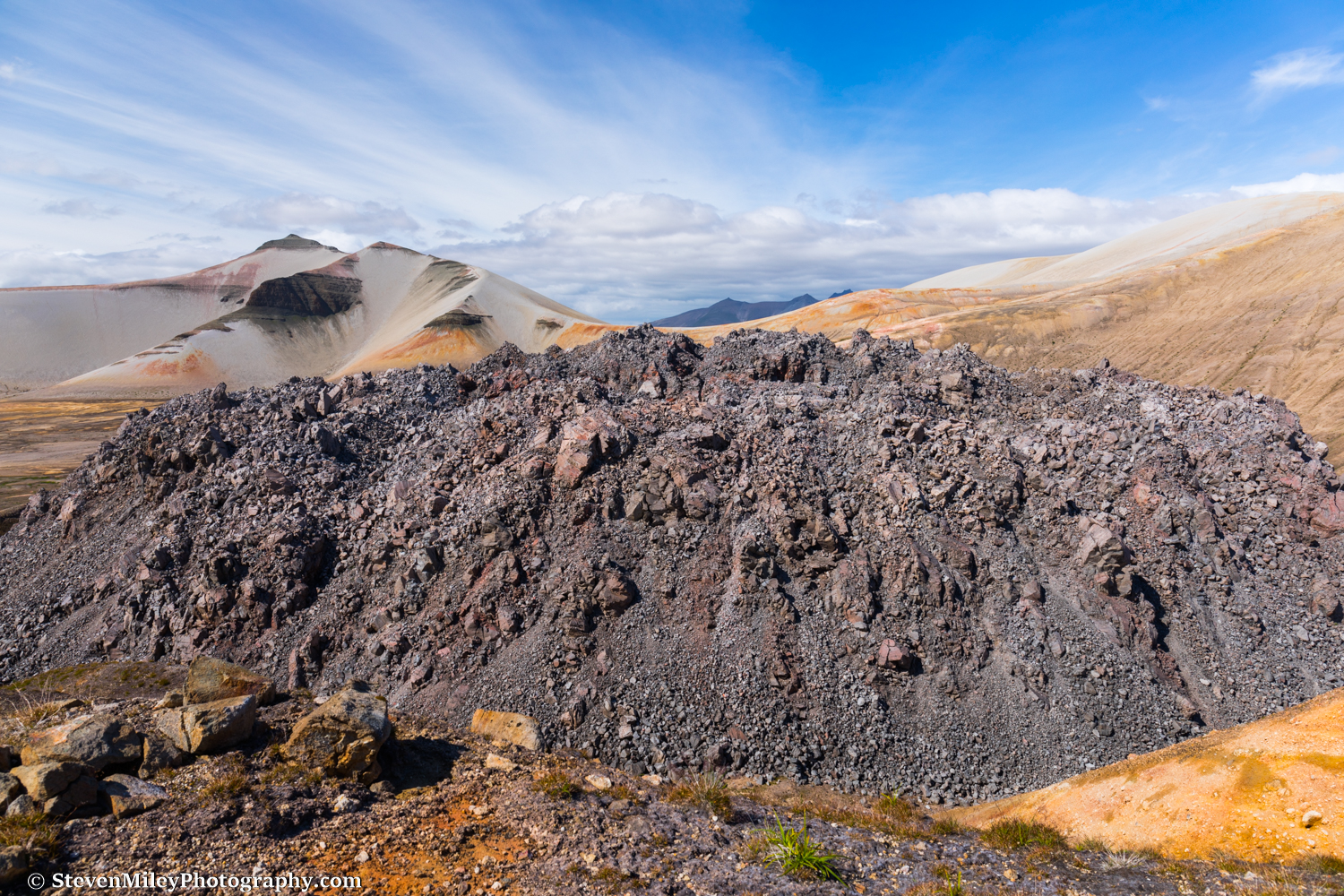
The Buttress Range along the western edge of the Valley of 10,000 Smokes in Katmai National Park, viewed from the side of Baked Mountain.

The Buttress Range along the western edge of the Valley of 10,000 Smokes in Katmai National Park, viewed from the side of Baked Mountain.

When I stepped out of the bush plane and felt my foot sink into the ash and pumice, I instantly knew I was in a different place. It looked like a desert except for the blue glacier ice and waterfalls spilling down Mt. Mageik in the distance. And, unlike the desert, the breeze was cold. I was standing in the Valley of 10,000 Smokes in Katmai National Park, a land still recuperating from the devastating eruption of Novarupta in 1912. Some 25 or 30 miles away, tourists were crawling over each other trying to get shots of brown bears catching salmon. But I had this intriguing desolation all to myself, and I wouldn't see another human until my pilot returned to pick me up six days later.

After the plane took off, I began shuttling my gear to the nearby Baked Mountain Huts, a pair of huts located half-way up Baked Mountain in the heart of the valley. The huts were built in 1965 and occasionally serve as a camp for researchers, but they are available to the public for free on a first-come, first-serve basis. I passed several fragments of the huts on the side of Baked Mountain as I climbed up the slope (a sign of the intense weather frequently seen in the valley) and I sincerely hoped "blowing pumice" would not be in the forecast during my stay. I settled into the smaller of the two huts, which was a bit drafty and dark but much more comfortable than sleeping outside in the wind. With the huts as my base camp, I planned to visit the Mt. Katmai caldera and its impressive crater lake, and I also planned to spend time backpacking outside the valley on the other side of Katmai Pass where few people venture.

The smaller of the Baked Mountain Huts. Four beds, a table, storage space, and even electrical outlets if you happen to bring a generator. 

The smaller of the Baked Mountain Huts. Four beds, a table, storage space, and even electrical outlets if you happen to bring a generator. 

The next day dawned sunny and warm, and I took my time soaking in the exotic landscape as I hiked to the base of the Knife Creek Glaciers with a heavy backpack. I followed a social trail most of the way from the huts to the saddle between Baked Mountain and Broken Mountain, where I gained a sweeping view of Novarupta and the colorful valley surrounding it. The slope to the valley floor below was steep, but I practically ran down it on the soft ash. As I circled the rim surrounding the lava dome of Novarupta, I spied steam escaping from some boulders at the dome's base and naturally had to investigate. The steam was warm and carried a pungent smell of sulfur, but I couldn't see the fissure beneath the rocks from which it emanated.  

The lava dome plugging the Novarupta vent. Steam still wafts from various places on the dome.

The lava dome plugging the Novarupta vent. Steam still wafts from various places on the dome.

I continued over rolling hills of pumice and ash. Deep cuts carved into the landscape by snowmelt presented annoying obstacles, but they paled in comparison to the gorges carved into the valley floor by the River Lethe and Knife Creek which I saw from overhead on my flight in. (Harrowing jumps over those gorges are typically the crux for people who hike into the valley from the Three Forks Overlook.) The vast emptiness was contradicted by ubiquitous human footprints, but there wasn't a person to be seen. Clouds draped the peaks of Mt. Katmai and Trident Volcano, which steadily grew larger as I approached. After one final hill, the Knife Creek Glaciers came into full view, sprawling over the valley floor in a jumbled, ash-covered mess. 

The water discharging from the nearest glacier was filled with sediment, but there was snow hiding under wind-blown ash near its terminus. I scraped the ash off with my ice axe and scooped snow into my water bladder, which carried me through the next morning until I found clear running water higher up on the glacier. As the sun began to set, I pitched my tent in a quiet canyon near the foot of Whiskey Ridge with the glacier just a few dozen feet away. Incredible scenery with no people, no bears, no mosquitoes, and no wind...my kind of campsite!  

The eastern summit of Trident Volcano rises above one of the Knife Creek Glaciers near sunset. 

The eastern summit of Trident Volcano rises above one of the Knife Creek Glaciers near sunset. 

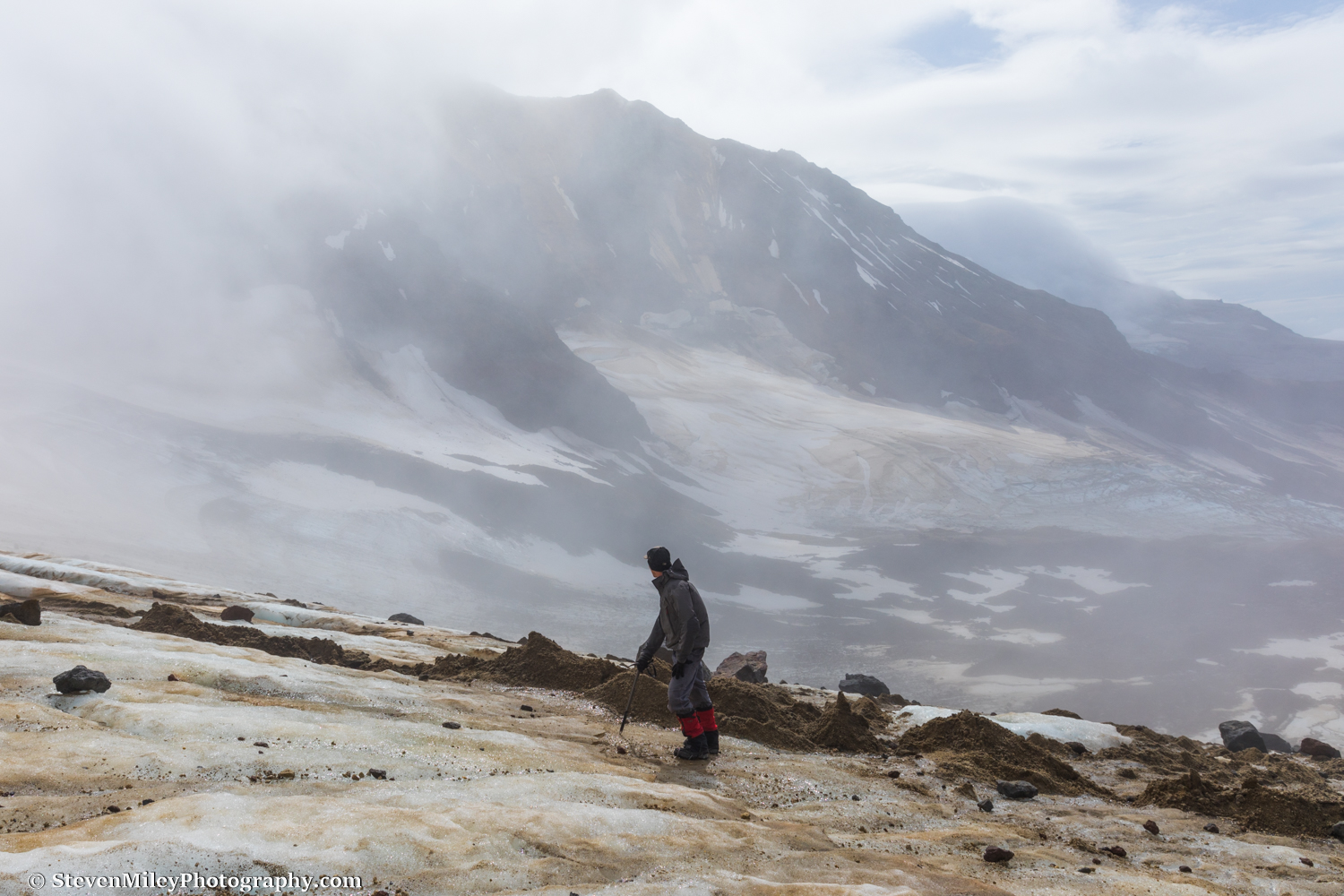
The next morning was overcast, but I thought the clouds swirling around the summits of Mt. Katmai and Trident Volcano would thin out later in the afternoon like they did the previous day, so I started following my planned route to the Mt. Katmai caldera. I’ve hiked over several rugged glacier moraines before, but the Knife Creek Glacier below Trident Volcano was on another level. Simply finding a place where I could start ascending the glacier was difficult, and I felt like a rat in a maze as I found my way around dead-ends and clawed my way over steep slopes of ice covered in loose ash. Eventually, I reached the bare ice beneath the eastern summit of Trident Volcano, where I found bright yellow-green olivine crystals sprinkled over the surface. When snow-filled crevasses began squeezing my path, I started following the ash-covered ice to my left, crossing a few hard-packed snowfields on my way to the pass between Mt. Katmai and Trident Volcano, which remained obscured by clouds.       

Ascending a steep section of ice between Trident Volcano and Mt. Katmai. The view is looking WSW toward East Trident. 

Ascending a steep section of ice between Trident Volcano and Mt. Katmai. The view is looking WSW toward East Trident. 

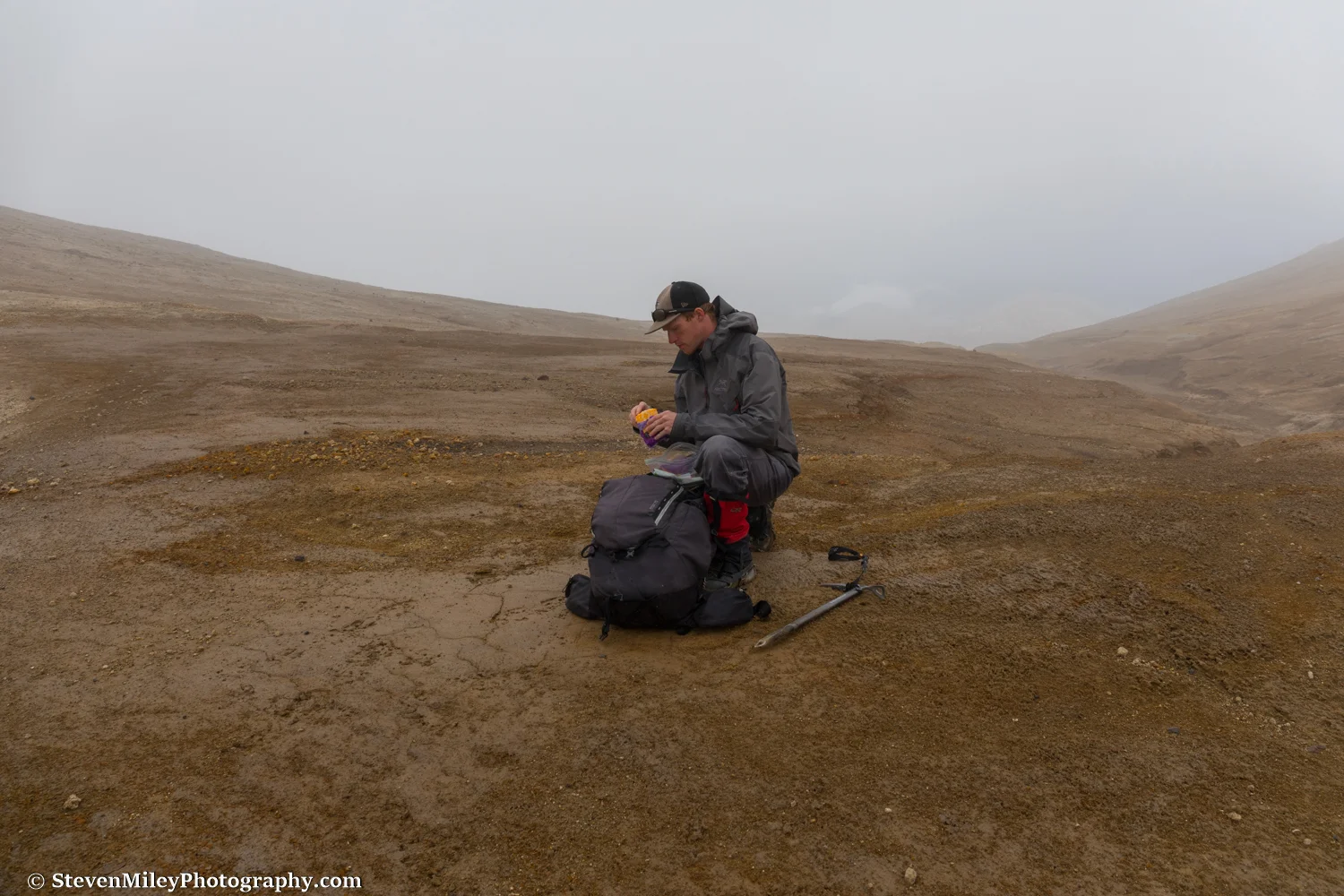
After I entered the clouds, I couldn't see much more than a few hundred feet in any direction. I reached the pass and took a break to eat some cheese and chocolate chips. From there, I had hoped to have a good view of the ridge leading to the peak on the western rim of the Mt. Katmai caldera (elevation 6128') and climb it if it looked manageable, but even though the ridge was right in front of me I couldn't see it. I switched to my backup plan, which was to cross over the pass and hike up the gentle slopes on the south side of the caldera the next day if the weather improved. (The usual route people take to the caldera follows one of the other Knife Creek Glaciers, but that route features crevasse danger and it looked much less pleasant in early August in person than in pictures I had seen of it taken in early summer with more snow cover.)

Pausing for some cheese at the pass between Trident Volcano and Mt. Katmai. The rounded top of Broken Mountain is barely discernible through the clouds to the right of my head.

Pausing for some cheese at the pass between Trident Volcano and Mt. Katmai. The rounded top of Broken Mountain is barely discernible through the clouds to the right of my head.

I began descending from the pass down the Wishbone Glaciers (what's the with the plural names, Katmai?) and quickly realized visibility wasn't improving as I had expected it would. The glacier also turned out to be far less benign than I had hoped. Hard-packed snow still blanketed much of its surface, and even though I felt comfortable sticking to the edge of the snow near the ash-covered moraines, there were gaping crevasses (and I mean gaping) crisscrossing the glacier on my left that dissuaded me from drifting over the snow toward Mt. Katmai. Traveling along the gnarled moraines didn't seem perfectly safe, either, as some of the crevasses that extended into the moraines were partially covered by ash bridges, and several small ash "sinkholes" I passed made me worry that one might open up at any time beneath my feet. With no landmarks available for route-finding and no way to see problematic terrain in advance, my progress was incredibly slow, and I soon found sunset approaching with no idea when or if the glacier might mellow out below. I started working my way toward the western edge of the glacier, climbing over hill after hill and taking circuitous paths around nasty crevasse mazes.

Suddenly, a mountain slope emerged from the mist in front of me. It was the edge of Trident Volcano. I crossed to the bottom of the ash-covered slope and followed it along the edge of the glacier until I found a flat spot where I could place my tent. Looking up, I could just barely see a ridge topped with craggy volcanic rocks leading up into gray nothingness. Looking around, I noticed several of those rocks had toppled down the slope and landed near my chosen campsite, so I set up my tent behind the largest boulder and hoped it would block anything that might tumble downhill while I slept.

I awoke later that night to the steady pitter-patter of rain on my tent. I shifted in my sleeping bag and heard the sloshing of water at my feet, and when I looked I saw a small puddle forming on the floor of the tent. Great, my tent is leaking. My sleeping bag seemed dry enough (except for my toes), and since there wasn’t anything I could do about it, I went back to sleep.

When I rose in the morning it was still raining. I glanced outside the tent and the visibility had deteriorated even further. Drips of water were slowly but steadily falling from the roof of the tent and my sleeping bag was damp. I waited an hour or two to see if the weather showed any signs of clearing, but there was no change. I reluctantly gave up on climbing to the caldera and decided to traverse the south side of Trident Volcano to Katmai Pass, where I expected to find drier weather or at least better visibility in the Valley of 10,000 Smokes. 

Hiking over the unfamiliar, extremely rugged terrain in poor visibility proved very laborious. I generally erred on the side of maintaining or increasing my elevation since I knew somewhere down below there were cliffs, creeks and glaciers that I wanted to avoid, and keeping the incline of the volcano to my right helped me stay pointed in the right direction. I still had to cross one narrow ash-covered glacier, which featured several steep hills of ash that I used my ice axe to help ascend. At one point, I stumbled into the fumarole field on the southern flank of Trident Volcano. I felt like I was walking on an alien moon as steam issued from yellow-green splotches on the ground all around me. I had read a paper before my visit that mentioned the volcanic gases in this area posed a potential danger to people, but the wind was blowing heavily so I didn’t think there would be any risk in continuing forward. I paid close attention for any signs of bodily distress, but I experienced no problems other than the overwhelming rotten-egg smell of sulfur forcing me to breathe through my mouth. Just in case the air was indeed toxic, I decided not to stop for a picture, which I regret because the scene was easily the most outlandish I've ever laid eyes upon. Oh, well—the image in my head will still haunt my dreams forever.

Moss grows beside a stream emerging from the lava flow on the southwest side of Trident Volcano. 

Moss grows beside a stream emerging from the lava flow on the southwest side of Trident Volcano. 

I continued circling around Trident Volcano, anxious to find a landmark. After what seemed like hours of turning slightly right and wondering if one of the shadowy bear-sized boulders that kept appearing out of the mist might turn out to be an actual bear, I finally hit the lava flows on the southwest side of the volcano, which were deposited over the years 1953-1974. Hiking over the slippery, sharp volcanic rocks would have been slow and treacherous, so I was forced to detour miles around them and give up quite a bit of elevation. I soon began seeing caribou tracks, the first tracks of any kind I had seen for two days. Then I saw something really striking: green vegetation! A stream emanating from beneath one of the lava flows had given life to moss and shrubs that appeared neon green against the drab landscape enveloped by the gray backdrop. I thought the stream might be warm, but when I reached my hand in it was unpleasantly cold. I stepped over it and quickly encountered several more streams which flowed over vivid orange rock. The vegetation near the streams became heavy, and so did the bear tracks. I encountered fresh bear scat and began to shout as I walked to avoid a surprise encounter.

When I neared the base of Mt. Mageik, the clouds lifted just enough that I could see the way forward would require a couple stream crossings before opening into a wide plain between the bases of Mt. Mageik and Trident Volcano. Bear tracks and trails were everywhere. I crossed two swift, knee-high glacial streams, and I thought after that I was nearing Katmai Pass until I checked my GPS coordinates against my map—I still had three miles and 1000 feet of elevation gain left! And there were only two hours before dark! As I gained modest elevation walking over the plain, the clouds once again engulfed me and I began relying on my InReach to point me north since every direction looked the same. For a brief moment a skinny white object appeared about a half-mile away near the lava flows to my right, but the clouds quickly snatched it from view. Was it a person? A tent? A cabin? As much as I wanted it to be an opportune shelter, I assumed it was most likely a seismic monitor or some other scientific instrument, and I continued on without investigating it. 

I crossed another sizable creek (perhaps the main branch of Mageik Creek) and followed it upstream into a valley where I began angling up the western side. When I reached an elevation equivalent to Katmai Pass, the clouds were still thick around me and the wind was blowing like crazy, and it was starting to get dark fast. My rain jacket had "wetted out" and my inner layers were damp, and I definitely couldn't rely on my drafty tent and soaking sleeping bag to keep me warm. Yet, dire as the situation may have seemed, I reasoned my worst case scenario was hiking all night in the dark to stay warm. It would at least get me to the peanut M&Ms I left at the Baked Mountain Huts sooner. 

It grew dark to the point where I started using the screen of my InReach as a flashlight in between checking it to make sure I stayed heading north. The creek running in the valley below finally caught up to me and I crossed it, and I knew Katmai Pass was incredibly close. I could only tell I had crossed the pass after I noticed I had been walking at a slight downhill incline for a lengthy time, and, disappointingly, the weather showed no sign of improving. I started following a dried up stream bed knowing it could only lead downhill, and it eventually brought me to a miniature slot canyon carved into the ash and pumice. The canyon provided the shelter from the wind I needed, so I hopped inside and used the rain fly of my tent to protect me and my pack from the light drizzle. I managed to stay marginally warm and may have even caught an hour of sleep while I waited for sunrise.

When daylight returned, I peeked over the canyon wall and couldn't have been more delighted to see Baked Mountain straight ahead. The clouds had lifted! I realized I had taken shelter between Falling Mountain and Mt. Cerberus without knowing either mountain was beside me. The weather still looked awful over Katmai Pass behind me, and the wind was still blowing fiercely, but there was sunshine in the Valley of 10,000 Smokes and I started hiking toward it like a moth to a flame. 

Drying out my sleeping bag and sweatshirt on the larger of the Baked Mountain Huts. 

Drying out my sleeping bag and sweatshirt on the larger of the Baked Mountain Huts. 

Back at the Baked Mountain Huts the sun was shining and the wind was blowing. I changed into dry clothes and hung my gear outside to dry. Completely exhausted, I relaxed at the huts for the rest of the day and read through a number of the logbook entries from the 1996 - 2006 era. (The most recent logbook volume apparently suffered water damage and was illegible.) A few entries detailed trips on the other side of Katmai Pass, and the descriptions of the terrain left me longing to go back from where I had just come—in better weather. I went to bed early that night before howling wind and rain arrived. 

Caribou tracks and an odd patch of glacier ice near East Mageik Lake.

Caribou tracks and an odd patch of glacier ice near East Mageik Lake.

On my last full day in Katmai National Park, I set out to see the Mageik Lakes, a pair of lakes about a mile apart near the base of Mt. Mageik. I started descending Baked Mountain only to realize a few hundred feet down that I left my camera behind. My legs complained heavily as I climbed back up the slope to fetch my camera, and I knew I'd be crawling my way back to the huts later. I crossed the valley floor with the wind blowing in my face, watching the low clouds drift over the lakes in the distance and hoping the rain would hold off as I plodded past colorful extinct fumaroles. I walked beside the River Lethe for a stretch where it flowed even with the valley floor rather than in a deep canyon, and in that form it looked no more intimidating than any of the other glacial creeks I've waded across.

I made it to the edge of the eastern lake just as light drizzle began falling. A medium-sized waterfall and a couple smaller streams originating from glacier ice on the northern slopes of Mt. Mageik above fed the lake, and it discharged into a 10-foot deep canyon. I walked to the end of the canyon looking for a good crossing spot, but the rain intensified and started hammering the other lake, and I was forced to give up on seeing it and its more impressive waterfalls. The rain finally cleared as I slowly climbed up Baked Mountain back to the huts, and I was treated to one of the better sunsets I've seen this summer.

Perfect weather graced my final morning in Katmai. Heavy fog filled the lower valley, but in the other direction I could finally see the entirety of Mt. Mageik, whose upper half had remained concealed during my entire trip. The dark clouds swirling over Katmai Pass behind Mt. Cerberus were gone, and the jagged peaks along Mt. Katmai's crater rim were completely unobscured. The wind had completely disappeared. I was disappointed I wouldn't get to enjoy hiking on such a nice day, but at least I didn't have to worry about my pickup being delayed by bad weather.

Morning fog blankets the lower Valley of 10,000 Smokes.

Morning fog blankets the lower Valley of 10,000 Smokes.

I decided I was only making one trip to carry my gear down to the valley floor. I put everything that could survive a good tumble into my duffel bag, then rolled the bag and my tent down the side of Baked Mountain. I carried the rest of my gear down in my backpack and retrieved my duffel bag and tent near the bottom, then found a good landing spot for the plane and made a windsock with my ice axe and a roll of toilet paper. While I waited for the plane, I carried a wash cloth and a clean shirt to the River Lethe and tried to clean up as best I could before returning to society. The plane arrived right on time and I climbed in, sad to leave but anxious to get a hot meal in King Salmon. 

I barely scratched the surface of the volcanic backcountry of Katmai National Park. It's the most unique place I've been in Alaska, and I can't wait to go back...with more food and a better tent!

The Baked Mountain Huts at sunset with Trident Volcano in the background.

The Baked Mountain Huts at sunset with Trident Volcano in the background.